A line bisection test in one mark
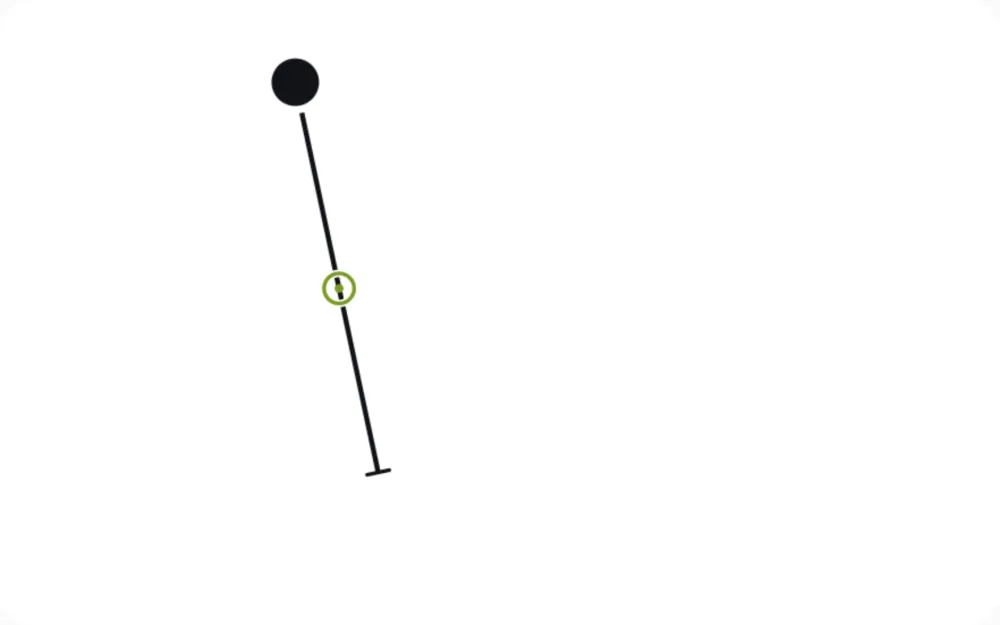
This line bisection test shows one straight line and asks a single thing: where is its middle? A ring sits on the line, and you slide it until it marks the exact halfway point, then press Lock in. There is no ruler and no grid, only your eye.
The first rounds are level lines, like the paper version of the task. Then the line tilts, never close to level or upright, so the edges of the screen give no help. The line runs from 260 to 620 pixels, and its middle is kept off the middle of the board, so aiming for the center of the card does not work.
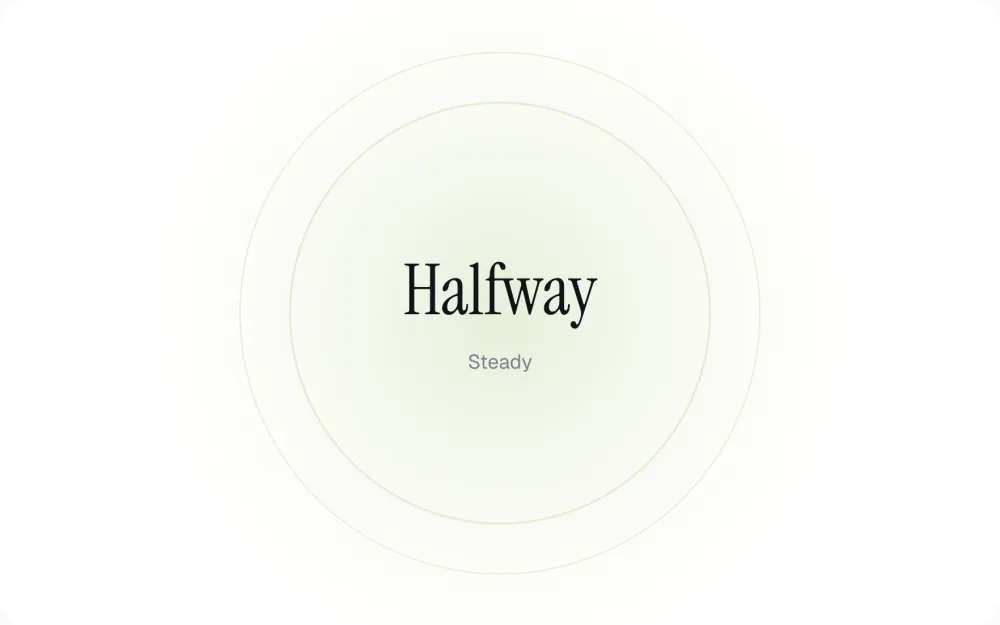
In the game this test is called Halfway, and it opens with its name in soft leaf-green rings and the level written underneath. A small drawing beside the instructions shows the rule: the ring slides to the middle and the two halves come out equal.
Sliding the ring
Drag anywhere on the board. The ring follows your finger or mouse along the line, always staying on it, so you can drag well away from the line and keep it in full view. On a computer, the arrow keys move the ring one pixel at a time for the last nudge.
From the middle of the run, the two ends stop looking alike. A large disc sits just past one end, and a small tick marks the other. Neither is part of the line. Only the stretch of line between its two ends counts, so the disc is a decoy that tugs at your sense of where the middle is.
On the hardest rounds the line shows for about a second and a half, then vanishes. The ring still slides along where the line was, and it does not stop at the hidden ends, so you have to set the middle from memory.
How the line bisection test is scored
Your miss is measured as a share of the line: how far the ring sits from the true middle, divided by the line's length. That way a long line and a short one score alike. Six pixels off on a 300 pixel line is the same 2% miss as twelve pixels off on a 600 pixel line. A perfect mark scores 100, and the score falls smoothly as the miss grows.
| Off the middle by | On a 400 px line | Score |
|---|---|---|
| 0% | 0 px | 100 |
| 1% | 4 px | 97 |
| 2% | 8 px | 88 |
| 3% | 12 px | 75 |
| 4% | 16 px | 61 |
| 6% | 24 px | 32 |
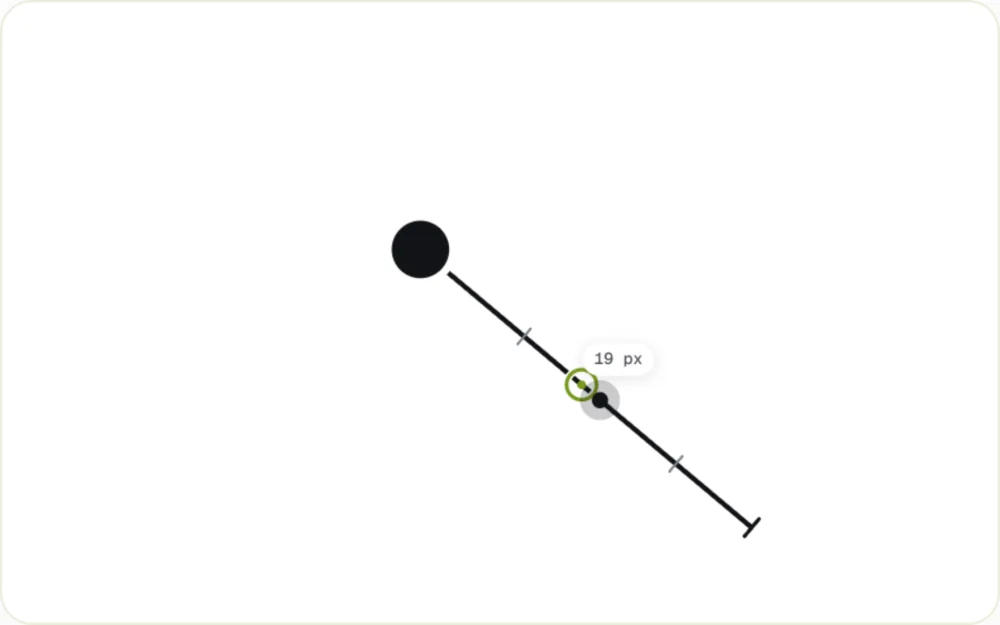
After you lock in, the line comes back with a solid dot on its true middle and one small tick across each half, to show the halves are equal. Your ring stays where you put it, and a label gives the miss in pixels. The verdict says which way you leaned, such as 9 px toward the big end.
What a line bisection test measures
Marking the middle of a line is one of the oldest tasks in the study of attention. In clinics, a line bisection test on paper is a standard check for spatial neglect, a condition that often follows a stroke on the right side of the brain. A person with neglect tends to ignore the left side of space, so the mark lands far to the right of the true middle, and the gap grows on longer lines.
Healthy people are not perfectly centered either. Most mark the middle slightly to the left, a small and consistent bias known as pseudoneglect. A review by Jewell and McCourt in 2000 pooled 73 studies and more than two thousand people and found it clearly. It is usually tiny, a percent or two of the line, and it changes with line length, the hand you use and where the line sits.
Things at the ends matter too. Cues placed at one end draw attention to that side and move the mark, and illusion figures show that shapes attached to a line change how long each part of it looks. That is why this line bisection test adds a disc to one end on harder rounds: it measures how well you hold on to the line itself.
This is a game, not a medical test. Clinicians use line bisection alongside other tasks, and a few off rounds here say nothing about your health.
Tips for a better line bisection test score
- Look from one end to the other and back before you drag. A line bisection test rewards seeing the whole line, not just the nearer end.
- Compare the two halves with each other, not the ring with one end.
- Ignore the disc. It sits outside the line, and counting it pushes the mark toward that end.
- On a tilted line, judge the halves along the line itself, not by their height on the card.
- When the line will vanish, fix both ends in mind first, then halve the gap between them.
Watch the verdicts over a few rounds. Many people lean the same way again and again, toward the disc or away from it, and a small, steady correction fixes most of the miss.
Halfway in Perceptle
Halfway is the newest test in Perceptle, a free game of quick perception tests, each scored out of 100. For now it plays in Unlimited and on this practice page. It joins the daily lineup once enough rounds have been played to set its scoring fairly against the other tests.
On this practice page each new round is a little harder than the one before, and you can pick the level you start at. For more judging by eye, try the symmetry test, the balance point test or the optical illusion test. How to play explains the daily game.
Questions and answers
What is a good score on the line bisection test?
Within 1% of the line scores 97, and 2% off scores 88. A miss of 4%, 16 pixels on a 400 pixel line, scores 61.
Does the disc at the end count as part of the line?
No. The disc sits just past one end, with a small gap, and the tick marks the other end. Only the line between them counts.
Why is my mark always a little off to one side?
Most people have a small, steady lean, often slightly to the left. The verdict after each round shows yours, so you can correct for it.
Can this line bisection test detect neglect?
No. It is a game, not a clinical test. If you are worried about your attention or vision after an illness or injury, talk to a doctor.
Does the line bisection test work on a phone?
Yes. Drag your finger anywhere on the board. The ring follows along the line, so your finger never hides the middle.
Is it free?
Yes. Perceptle is free in any browser, with no account and nothing to install.
Find the middle
Try a few rounds of Halfway, then play today's Perceptle and see how your eye for the middle compares with your sense of time, color and memory.
Play today's Perceptle