A symmetry test with a slanted mirror
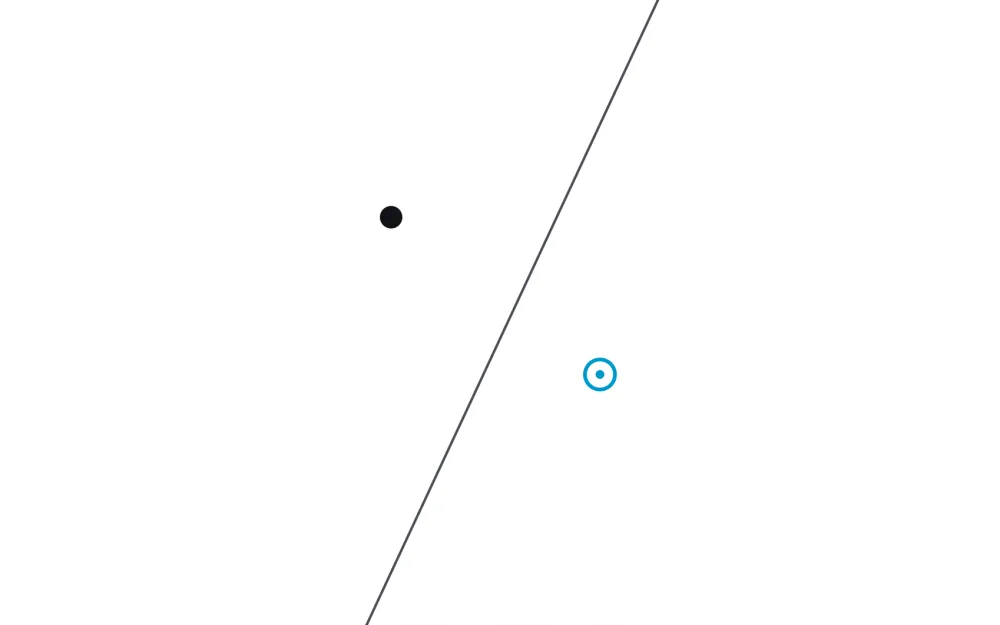
This symmetry test gives you a straight line and a single dot. The line is a mirror. Your job is to tap the spot where the dot would land if it were reflected across that line, drag to adjust if you need to, then press Lock in.
The mirror is never level and never upright. It is always slanted, at one of eight angles, and that one detail is what makes the symmetry test hard. A reflection across a vertical line is easy to picture. Across a tilted one, your sense of straight across starts to wobble.
On harder rounds the dot sits farther from the mirror, so a small error in direction grows into a bigger miss on the far side. In the game this symmetry test is called Mirror Point, and it opens with its name in soft blue rings and the level written underneath.
How to find the mirror point
Every round of the symmetry test comes down to two rules. The mirror point is the same distance from the line as the original dot, and it sits straight across the line, along a path that meets the mirror at a right angle. Get both right and you have the answer.
The easiest way to use those rules is to imagine folding the screen along the mirror line. Where would the dot press into the other half? Picture the fold, then tap there. The habit pays off most on late rounds, when the dot sits far from the line.
If you prefer a method, first find the point on the line closest to the dot, then continue the same distance past it. Most misses on the symmetry test come from that first step: people head straight down or straight across the screen instead of square to the slanted line.
Symmetry test scoring, in pixels
Your error is the straight distance between your ring and the true mirror point, measured in board pixels on a board 800 wide and 500 tall. The board scales to your screen, so a 35 pixel miss counts the same on a phone as on a laptop. A perfect tap scores 100, and the score falls away smoothly as the distance grows, so a near miss still earns most of the points.
| Distance from the mirror point | Score |
|---|---|
| Spot on | 100 |
| About 17 px | 88 |
| 35 px | 61 |
| 52 px | 33 |
| 70 px | 14 |
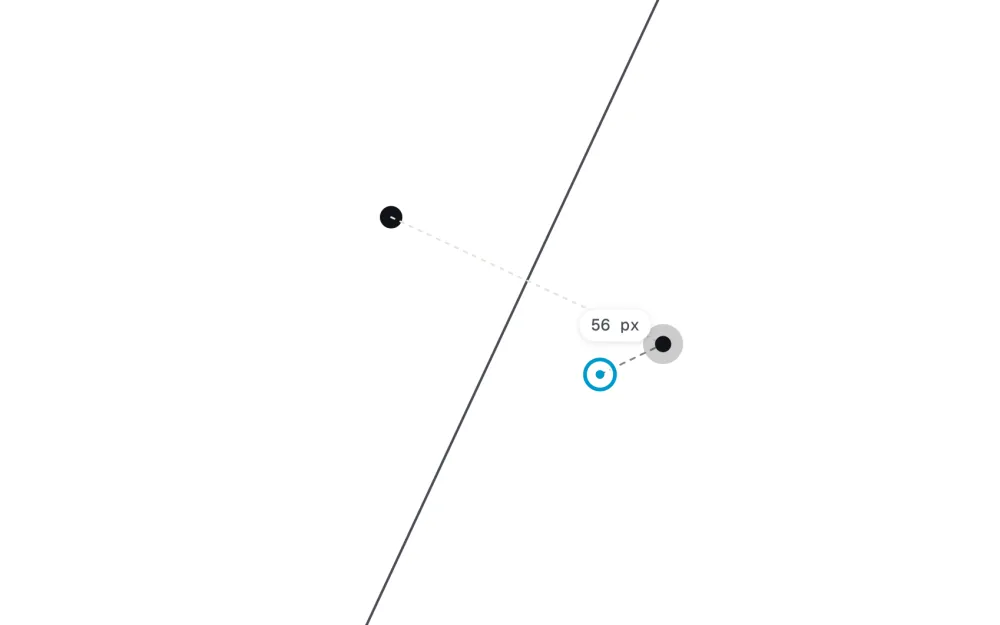
After you lock in, the true mirror point appears as a dark dot. A faint dashed line joins the original dot to its reflection, so you can see the path it should have taken, and your ring is linked to the true point with the distance written beside it, such as 115 px.
Why every mirror in this symmetry test is slanted
Mirror symmetry is one of the strongest cues vision has. We spot it almost instantly in faces, leaves and buildings, especially when the axis runs straight up and down. That upright case is so easy that it would make a dull symmetry test.
Symmetry about a tilted axis is harder to see and harder to judge. Upright mirrors are the easiest, level ones come next, and slanted ones leave you with the fewest shortcuts. That is why every mirror here is slanted: the task then measures your sense of space rather than a reflex.
You may notice that the angle matters too. Some slants feel natural and others feel awkward, and a few rounds will show you which ones pull your taps off course.

Common mirror point mistakes
- Reflecting square to the screen. On a slanted mirror, the path to the reflection is square to the line, not to the edges of the board.
- Misjudging the distance. Check that your ring sits as far from the mirror as the original dot does.
- Sliding along the line. If your ring drifts up or down the mirror, the dashed line in the reveal will show it clearly.
- Tapping before you picture the fold. A second spent imagining the reflection saves more time than dragging afterward.
Most misses fall into one of these patterns. After a few rounds of the symmetry test, the reveal makes it obvious which one is yours, and fixing it is usually quick.
Mirror Point in the daily Perceptle
This symmetry test is one of twelve perception tests in Perceptle, a free daily game of ten quick tests, each scored out of 100 for a total out of 1000. Ten of the twelve are drawn each day and get harder from first to last. Everyone plays the same puzzle on the same date, and a new one arrives at local midnight.
On this practice page each new round is a little harder than the one before. For more tests of space and geometry, try the circle center test or the balance point test. How to play explains the daily game.
Questions and answers
What is a good score on the symmetry test?
Landing within about 17 pixels of the true mirror point scores 88, and 35 pixels off scores 61, on a board 800 pixels wide.
Why is the mirror never vertical or horizontal?
Symmetry about an upright or level line is easy to see at a glance. Slanted mirrors make the symmetry test about judging the reflection rather than recognizing it.
What is the quickest way to find the mirror point?
Imagine folding the screen along the line. The reflection is the same distance from the line, straight across it at a right angle.
Can I move my answer after tapping?
Yes. Tap to place your ring, drag to adjust, then press Lock in when you are happy with it.
Does the symmetry test work on a phone?
Yes. On a phone held upright, the board turns to fill the screen.
Is it free?
Yes. Perceptle is free in any browser, with no account and nothing to install.
See the whole picture
The symmetry test is one of ten quick tests in today's Perceptle. See how your sense of space compares with your sense of time, color and memory.
Play today's Perceptle