How the time perception test works
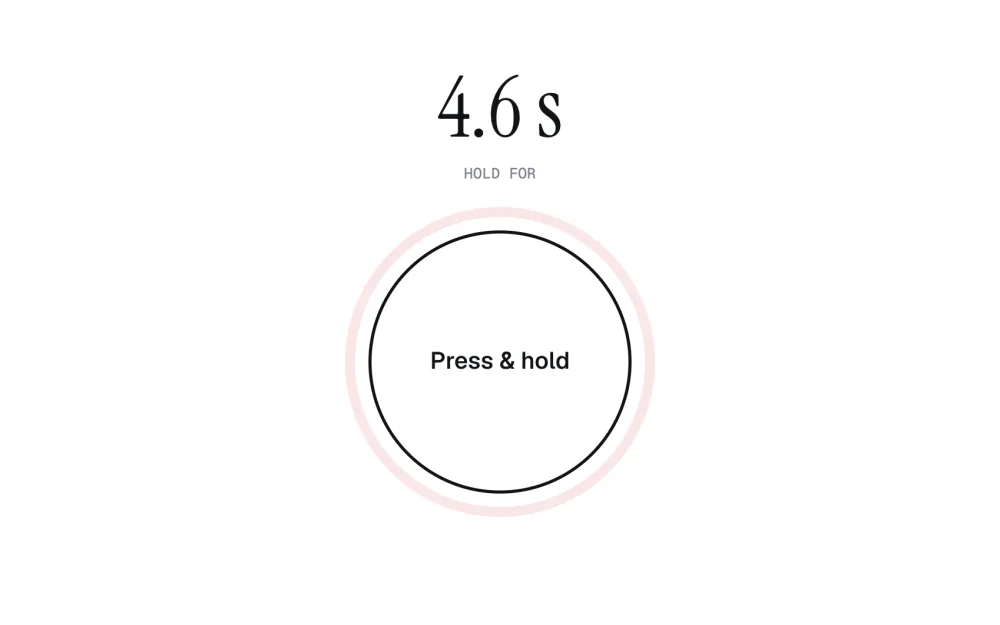
The Perceptle time perception test asks for one thing: hold the circle for exactly the time shown, then let go. The target sits in large type under the words HOLD FOR, somewhere between 2 and 7 seconds, such as 4.6 s. Press and hold the circle, or the space bar on a computer, and release when you think that much time has passed.
There is no timer while you hold. Nothing on the screen moves or counts, so the only clock you have is the one in your head. That is the point: this measures how well you can feel a stretch of time, not how well you can read one.
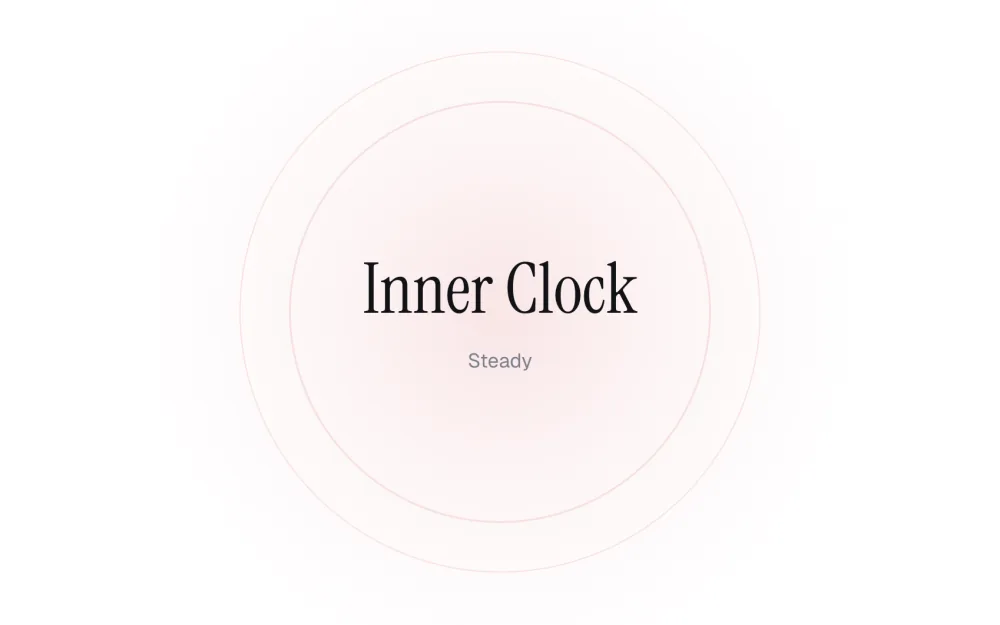
In the game the test is called Inner Clock, and its color is red. On this practice page each new round is a little harder than the last, and later rounds tend to ask for longer holds.
Press, hold, let go: the rules of a round
A round of the time perception test starts when your finger or the space bar goes down and ends when it comes up. Holds under a quarter of a second don't count. The screen says Keep holding instead, so a brush of the finger doesn't cost you the round.
If you switch to another window or tab in the middle of a hold, that hold is cancelled and you start again. Once the game loses sight of the press, it can't know how long you meant to hold, so it doesn't guess.
On a phone held upright the board turns to fill the screen, which gives the circle more room under your thumb.
How the time perception test is scored
Your error is how far off you let go, as a share of the target. Let go at 4.2 seconds on a 4 second target and you were 5% over. Using a share rather than raw seconds keeps long and short targets fair: missing a 7 second hold by half a second is a smaller slip than missing a 2 second one by the same amount.
Like every Perceptle test, it scores from 0 to 100, falling away smoothly as the miss grows: a small miss costs a little, a big one a lot.
| How far off | On a 4 second target | Score |
|---|---|---|
| Spot on | 4.00 s | 100 |
| 4% | 3.84 or 4.16 s | 88 |
| 5% | 3.80 or 4.20 s | 82 |
| 8% | 3.68 or 4.32 s | 61 |
| 12% | 3.52 or 4.48 s | 32 |
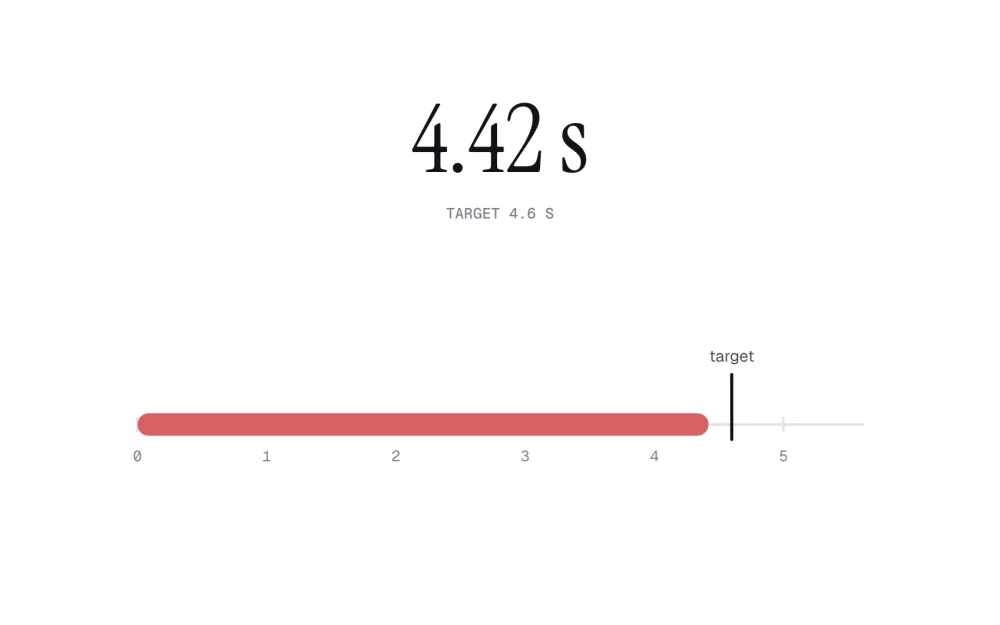
The reveal shows your held time in large type, 4.38 s for example, above a timeline marked in seconds. A tick marks the target, so you can see at once whether you let go early or late, and by how much.
What is normal: the science of short intervals
Psychologists call the task in a time perception test like this one time reproduction: you are given a duration and asked to produce it yourself. On short intervals like these, most people land within about 10% of the target. Within 5% is a good round, and within 2% is an excellent one.
Error grows with the length of the interval. Researchers call this scalar timing: the wobble in your sense of time is roughly a fixed share of the time itself, so a 7 second hold drifts by more seconds than a 2 second one. Scoring by percentage follows the way the inner clock really behaves, which is why a long target is not unfairly hard.
Your state matters too. Arousal and caffeine seem to speed up the internal clock, so time feels used up sooner than it is. When people are keyed up, they tend to let go early. If your misses are all on the short side, that may be why.
Tips for a steadier inner clock
- Read the target twice before you press, so you hold for 4.6 seconds rather than a rounded 5.
- Breathe out slowly before the press. A calm start guards against the early release that nerves bring.
- If you count, keep the beat even. A count that speeds up under pressure is the most common way to let go early.
- Use the reveal. Short three rounds in a row? Aim to hold a touch longer next time, not a lot longer.
- Play several rounds of the time perception test before judging your inner clock; one hold is a small sample.
The time perception test in the daily Perceptle
This time perception test is one of twelve tests in Perceptle, a free daily game of ten quick perception tests. Each day ten are drawn from the twelve and get harder from first to last, so Inner Clock can turn up early with a shorter target or late with a longer one. Everyone gets the same puzzle on the same date, and a new one arrives at local midnight.
The ten scores add up to a daily total out of 1000. If you enjoy judging without a reference, try the reaction time test or the speed perception test, or play Unlimited for endless mixed rounds.
Questions and answers
What is a good score on the time perception test?
Letting go within 4% of the target scores 88, and anything within 5% scores above 80. On a 4 second target, that means landing within 0.2 seconds. An 8% miss scores 61.
Can I count in my head during the time perception test?
Yes. Counting is allowed, and many people do it. The hard part is keeping the count even, since nerves tend to speed it up.
Why did the screen say Keep holding?
Holds shorter than a quarter of a second don't count, so a brief touch doesn't end the round. Press and hold again.
What happens if I switch tabs during a hold?
The hold is cancelled and you start again. The game only times a hold it can see from start to finish.
Why do I always let go too early?
It is very common. Feeling rushed or alert seems to speed up the inner clock, so the time feels used up sooner. Try a slow breath out before you press.
Is it free?
Yes. Perceptle is free in any browser, with no account and nothing to install.
Ready for the other nine?
The time perception test is one of ten quick tests in today's Perceptle. Hold, match, judge and remember your way to a score out of 1000.
Play today's Perceptle