The speed perception test, step by step
This speed perception test has two parts. First, a dot crosses its track once, from one end to the other. Watch it closely, because you only see it go by one time. The crossing takes somewhere between about 1.5 and 3.5 seconds, and harder rounds use faster dots.
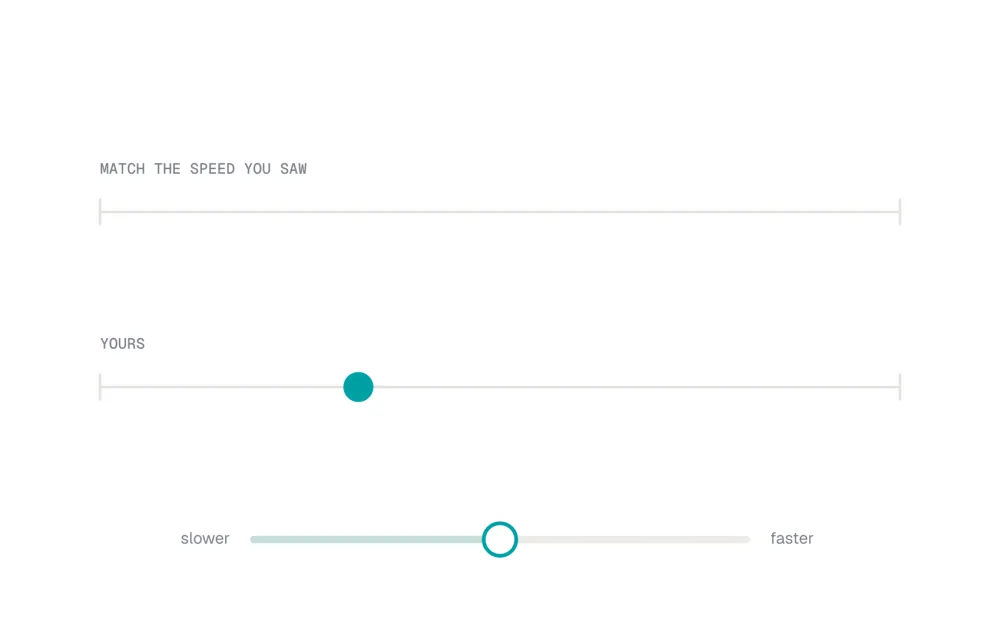
Then a second dot starts looping along its own track, and a slider appears underneath, running from slower to faster. Drag the slider until the second dot moves at the same speed as the first, then press Lock in. You can adjust as long as you like while the dot keeps running.
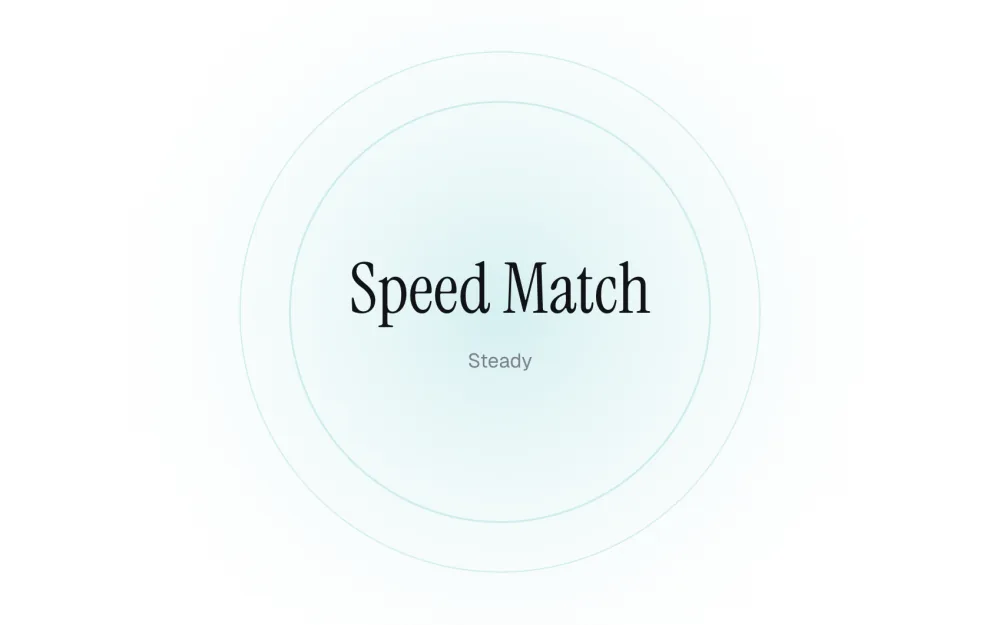
In the game this speed perception test is called Speed Match. It opens with its name in soft teal rings and the level written underneath, so you know what kind of round is coming.
Getting the most from the slider
The slider is built so that every step changes the speed by the same proportion. A nudge near the slow end makes as much visible difference as a nudge near the fast end, which means your hand and your eye stay in step wherever you are on the scale.
The best approach is a decisive first move followed by fine tuning. Jump straight to roughly the right speed, watch the dot make one or two laps, then adjust in small steps. Creeping up slowly from one end wastes the few seconds when your memory of the first dot is sharpest.
Stop when it feels right. Every extra lap you spend second-guessing is a lap in which your memory of the first dot fades a little more.
How the speed perception test is scored
Your error is the difference between your speed and the true speed, as a share of the true speed. If the first dot moved at 250 units a second and you set 270, you are 8% off. A perfect match scores 100, and the score falls away smoothly as the gap grows.
| Your miss | Score |
|---|---|
| Exact match | 100 |
| 4% off | 88 |
| 8% off | 61 |
| 12% off | 32 |
| 16% off | 14 |
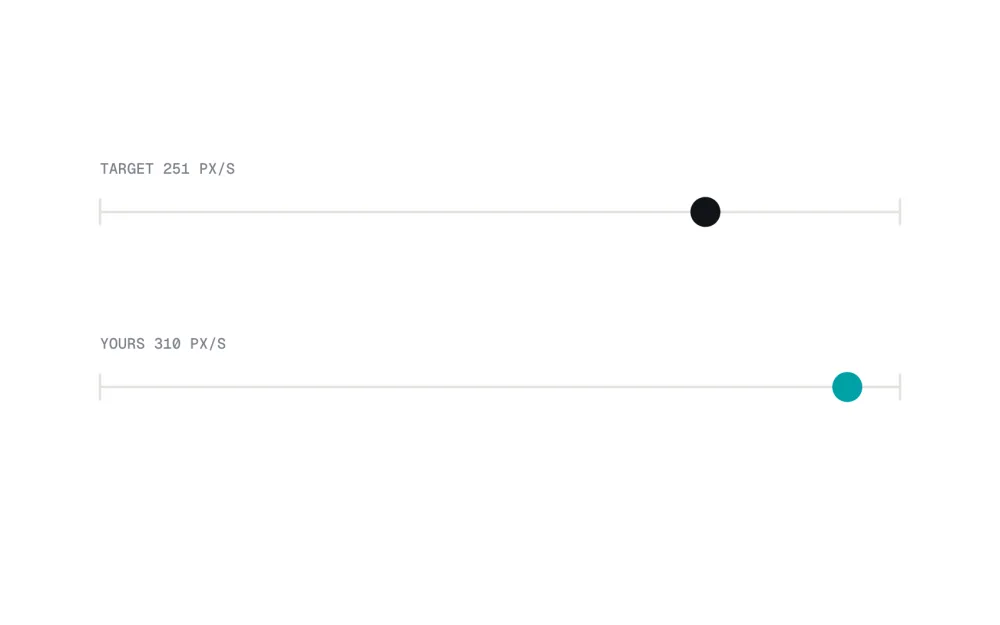
The reveal shows both dots on their tracks with their speeds in pixels per second, for example target 251 and yours 345, and a short verdict that tells you whether you were too fast or too slow and by how much. Watching for that verdict over several rounds tells you which way you tend to drift.
How good are people at judging speed?
Better than you might think. In careful lab conditions, people can tell apart two speeds that differ by only about 5 to 10%. That is close to the range where this speed perception test starts handing out high scores, so a strong round is well within reach.
The harder part is memory. In a speed perception test like this one, you are not comparing two dots side by side; you are matching a speed you saw a moment ago. That relies on a short-lived memory for motion, which fades quickly. It is why acting fast helps: the sooner you get close, the more of that memory is left for the fine adjustments.
You use the same skill every time you judge a passing car or catch a thrown ball. Your brain estimates speed from how fast something moves across your view, then holds that estimate for a moment while you decide what to do.

Tips for a closer match
- Give the first dot your full attention. You only get one crossing, so don't look away or reach for the slider early.
- Keep your eyes still near the middle of the track and let the dot pass through your view, rather than chasing it.
- Move the slider boldly first, then refine. Big jumps early, small steps late.
- If the dot looks right but you are not sure, watch one more full lap before you lock in.
- Check the verdict after each round. If you keep landing too fast, start your first jump a little slower.
Fast dots on late rounds are the toughest, because the crossing is short. A few practice rounds of the speed perception test make those quick crossings feel far less rushed.
Speed Match in the daily Perceptle
This speed perception test is one of twelve perception tests in Perceptle, a free daily game of ten quick tests, each scored out of 100 for a total out of 1000. Ten of the twelve are drawn each day and they get harder from first to last. Everyone plays the same puzzle on the same date, and a new one arrives at local midnight.
Here on the practice page, each new round is a little harder than the one before. If timing is your thing, try the time perception test or the reaction time test, or mix every test together in Unlimited.
Questions and answers
What is a good score on the speed perception test?
A match within 4% of the true speed scores about 88, and 8% off scores 61. Getting within a few percent is a strong round.
Can I watch the first dot again?
No. It crosses once, so the round tests your memory for speed as well as your eye. The second dot keeps looping while you adjust.
What happens if I switch tabs while the first dot is crossing?
The round is replaced with a fresh one, so you never have to match a speed you missed.
Why does the slider feel uneven?
It isn't. Each step changes the speed by the same proportion, so small moves feel equally small at the slow and fast ends.
Does the speed perception test work on a phone?
Yes. On a phone held upright, the board turns to fill the screen, giving the tracks as much length as possible.
Is it free?
Yes. Perceptle is free in any browser, with no account and nothing to install.
One dot down, nine tests to go
The speed perception test is one of ten quick tests in today's Perceptle. See how your sense of motion stacks up against your sense of time, color and space.
Play today's Perceptle