What the circle center test asks you to do
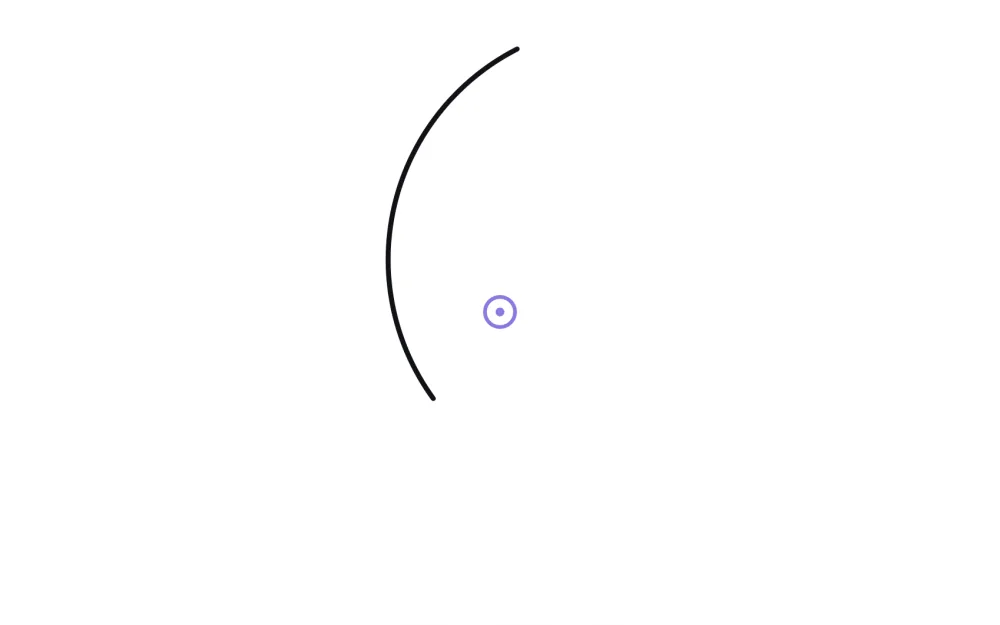
The circle center test shows you only part of a circle: a single black arc on a white board. The rest of the circle is hidden. Tap where you think the center of the whole circle would be, drag your mark to adjust it, then press Lock in.
The circles come in many sizes, with a radius between 130 and 230 units on a board 800 units wide and 500 tall, and the arc can face any direction. The center is always somewhere on the board, so you never have to aim at a point off the edge.
Each round of the circle center test begins on a short brief with its in-game name, Arc Center, and the level written underneath.
Why a shorter arc makes a harder round
How much of the circle you get to see sets the difficulty. On the easiest rounds the arc covers 150 degrees, a little less than half the circle. On the hardest it covers as little as 50 degrees, about a seventh. Less arc means less curve to read, and any misreading of its bend moves your answer further.
On this practice page each new round is a little harder than the one before, so the arc shrinks as you go. In the daily game the ten tests get harder from first to last, so a circle center test late in the lineup will hand you a short arc.
How to find the center of a circle from an arc
Finding a center from part of an edge comes down to judging curvature. A tight bend belongs to a small circle with a center close by. A gentle bend belongs to a big circle whose center sits far away.
Two facts from geometry help. The center is the same distance from every point on the arc. And it lies on the perpendicular from the arc's midpoint: picture a line leaving the middle of the arc at a right angle and heading into the curve. The center is somewhere along that line, so the only real question is how far along.
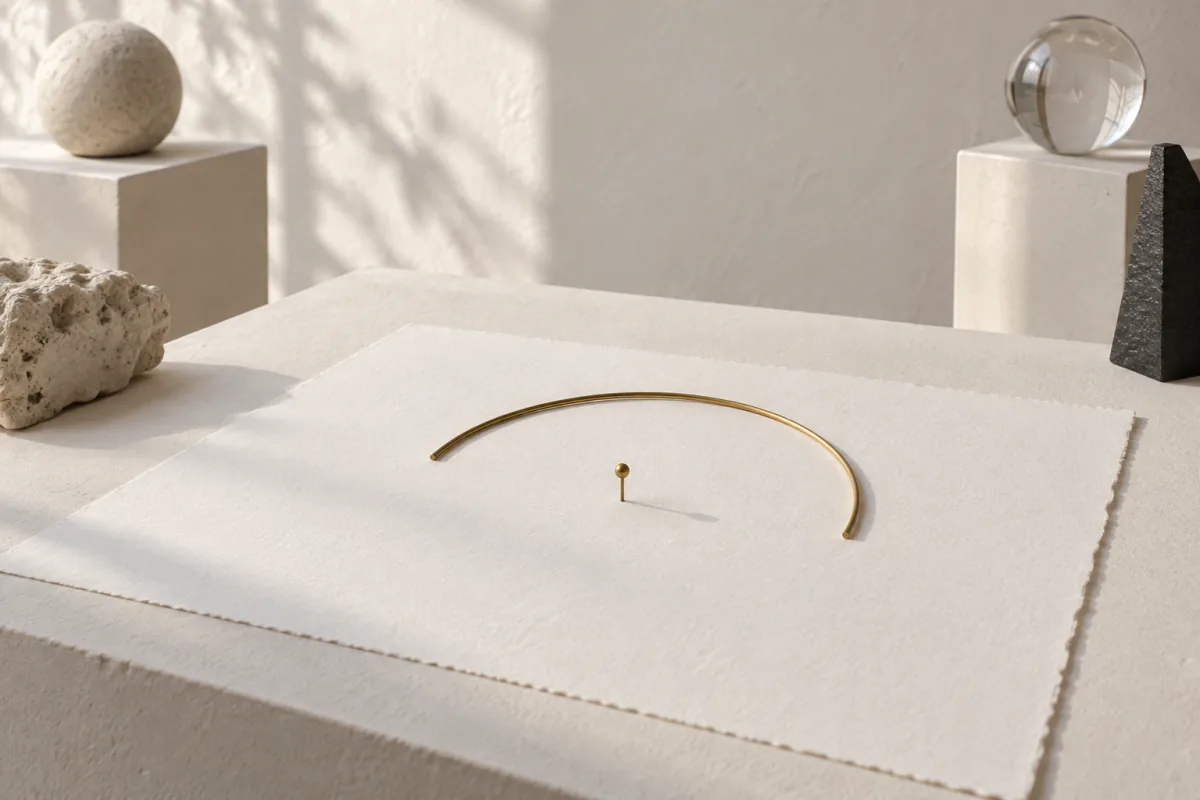
On paper you could draw chords and measure. In a circle center test there is nothing to draw with, so do it in your head instead. Picture the rest of the circle before you tap, trace the missing part until the ring closes, then put your mark in the middle of the ring you imagined.
How the circle center test is scored
Your error is the distance from your mark to the true center, divided by the circle's radius. Measuring against the radius means big and small circles are judged fairly: the same miss counts for more on a small circle than on a large one.
| Distance from the center | Score |
|---|---|
| Right on it | 100 |
| 4% of the radius | 88 |
| 8% of the radius | 61 |
| 12% of the radius | 32 |
| 16% of the radius | 14 |
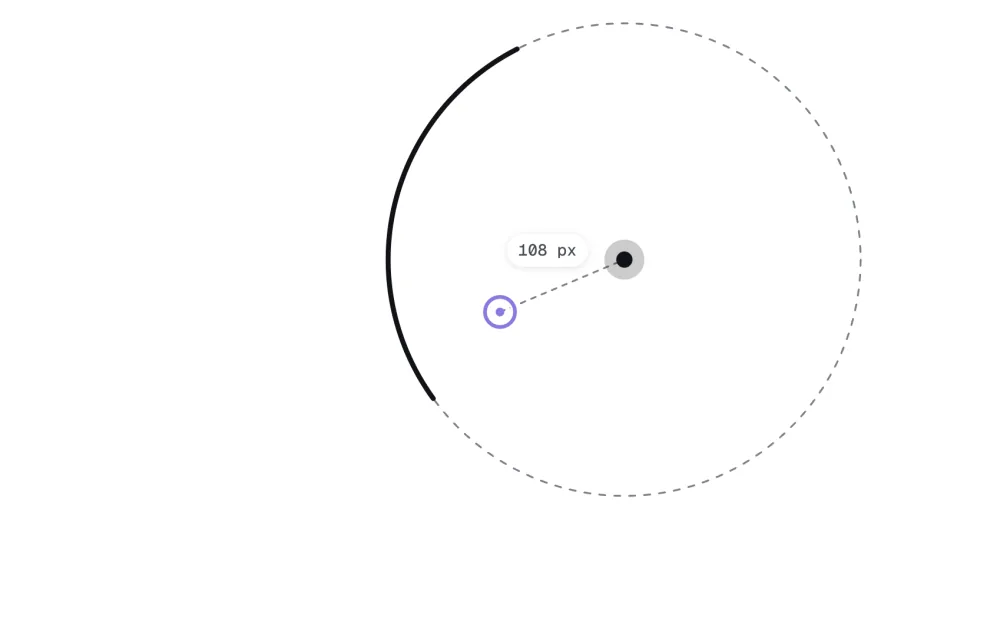
The score falls away smoothly, so a near miss still earns most of the points. When you lock in, the whole circle is completed as a dashed ring under the arc, the true center appears as a dark dot, and a line links your ring to it with the distance, such as 101 px. The full ring shows at a glance which way your eye leaned.
Why gentle arcs pull your guess too close
A frequent miss is a guess that sits too close to the arc. Large circles have gentle arcs that look almost straight, and a nearly straight line doesn't feel like it belongs to a circle with a distant center, so the mark lands short.
- Find the middle of the arc first, then look straight into the curve from there.
- Picture the missing part of the circle all the way around before you tap.
- If the arc looks nearly flat, the circle is big. Push your mark further out than feels natural.
- Check from the ends: your mark should be as far from each end of the arc as from its middle.
- After each circle center test round, look at where the dashed ring runs. It shows whether you pictured the circle too small or too large.
Arc Center in the daily game
This circle center test is one of twelve tests in Perceptle, a free daily game of ten quick perception tests. Everyone gets the same puzzle on the same date, a new one arrives at local midnight, and your ten scores add up to a total out of 1000.
For more geometry by eye, try the symmetry test, which asks where a dot would land if mirrored across a line, or the area estimation test, which asks you to match a circle's area with a square. Unlimited mixes all twelve into endless rounds.
Questions and answers
What is a good score on the circle center test?
A tap right on the center scores 100. Landing 4% of the radius away scores 88, and 8% away scores 61.
Why can a short miss cost more than a long one?
Because the circle center test measures your error against the radius. The same distance is a bigger share of a small circle than of a large one.
Is the center ever off the board?
No. The center is always on the board, even when the arc sits near an edge.
Why is a short arc so much harder?
There is less curve to read. A 50 degree arc gives your eye very little bend to go on, and a small misreading of it moves the center a long way.
Can I play on a phone?
Yes. Hold it upright and the board turns to fill the screen. Tap, then drag your ring to fine-tune it before you lock in.
Is it free?
Yes. Perceptle is free in any browser, with no account to make and nothing to install.
Ready for the full set?
The circle center test is one of ten quick tests in today's Perceptle. Try it alongside tests of color, memory, timing and space, and see your total out of 1000.
Play today's Perceptle