A rod and frame test in one line
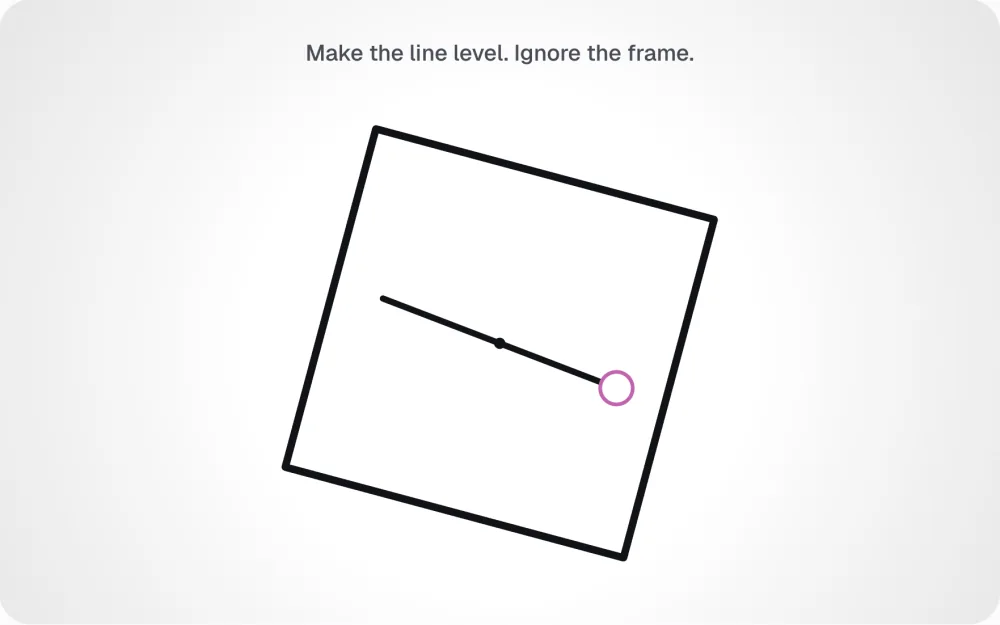
This rod and frame test shows a square frame, tilted to one side, with a single straight line inside it. Your job is to turn the line until it is truly level: flat like the horizon, parallel to the top and bottom of your screen. The frame is there to fool you. Being square with the frame does not count.
The frame leans anywhere from 12 to 32 degrees, sometimes left and sometimes right, and the harder rounds use the steeper tilts. The line starts at least 10 degrees off level, sometimes leaning the same way as the frame and sometimes the other way, so there is no shortcut. A soft round shadow darkens the corners of the board, so the frame is the strongest edge in view.
In the game this test is called Level It, and it opens with its name in soft rose rings and the level written underneath, along with a small drawing of the rule: a line leaving the frame's slant for a faint horizon.

Turning the line
When the round starts, one end of the line carries a ring in the test's color. Drag anywhere around the middle of the board to turn it, the way you would turn a dial. Your finger never covers the line, and the further from the middle you drag, the finer the control. On a computer, the arrow keys turn it one degree at a time.
Level always means level on your screen. On a phone held upright the board turns a quarter to fill the screen, but the line still has to lie flat across the phone, from one side to the other. When the two ends of the line sit at the same height, press Lock in.
Nothing here tests memory or speed. The rod and frame test measures one thing: how much a tilted surrounding pulls your own sense of level.
How the rod and frame test is scored
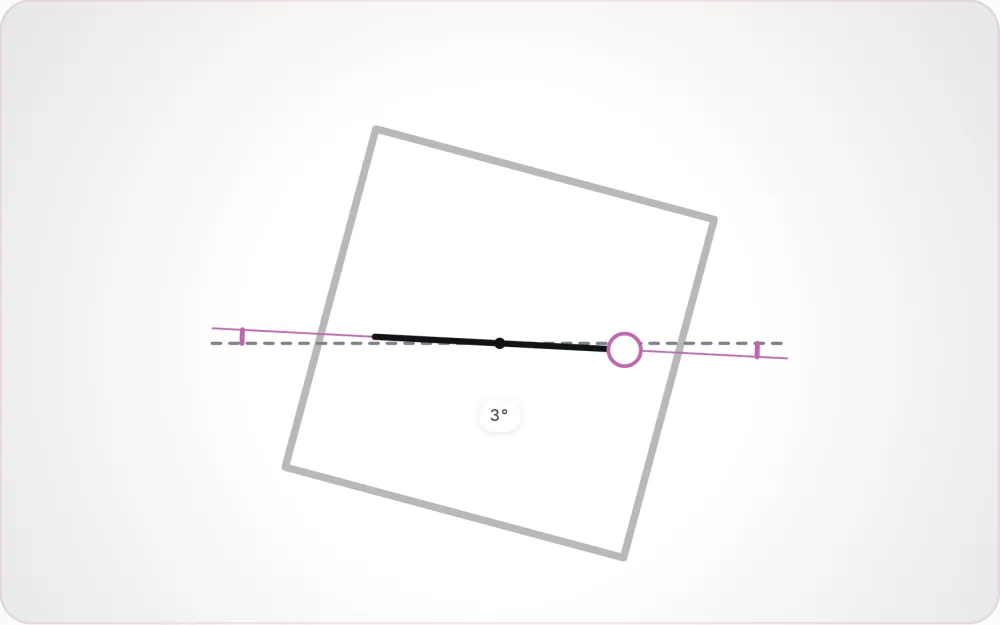
Your answer is scored by the angle left between your line and true level, in degrees. A perfectly level line scores 100, and the score falls smoothly as the gap grows. A line tilted 3 degrees one way scores the same as 3 degrees the other way.
| You are off by | Score |
|---|---|
| 0° | 100 |
| 1° | 97 |
| 2° | 88 |
| 3° | 75 |
| 4° | 61 |
| 6° | 32 |
This is a strict test, because people really are good at finding level when nothing gets in the way. After you lock in, a dashed line shows true level across the board, your line stays where you left it, and an arc marks the gap between them with a small label in degrees. The reveal also says whether you leaned with the frame or against it.
Where the rod and frame test comes from
The rod and frame test was devised in the 1940s by the psychologists Herman Witkin and Solomon Asch. In the original, a person sat in a completely dark room facing a glowing square frame with a glowing rod inside it. The experimenter tilted the frame, and sometimes the person's chair too, and the person told the experimenter how to turn the rod until it looked upright. Level It asks for level instead of upright, which is the same judgment turned a quarter.
Two sources of information compete in this task. The balance organs of the inner ear and the feel of your own body say which way is down. The frame says something else, because in everyday life walls, doors and window frames really are upright. Most people end up a few degrees off, leaning the rod toward the frame's tilt. The pull is strongest for moderate tilts of roughly 15 to 30 degrees.
Witkin found that people differ a lot, and in a stable way. Some set the rod close to true upright whatever the frame does; others are pulled far toward it. He called this a difference in field dependence, and made it the center of decades of research on perceptual and cognitive style. Screen versions of the rod and frame test are still used today, for example to study balance problems and how neck injuries affect the sense of upright.
On a screen the effect is milder than in a dark room, since the edges of the screen and the room around you also say where level is. That is why the board here fades its corners and why the scoring is strict: the frame only has to move you a degree or two to cost points.

Tips for a better rod and frame test score
- Compare the line with the top and bottom edges of your screen, not with the frame.
- Look at the line's two ends in turn: when they sit at the same height, it is level.
- Expect the pull. Most people lean the line a little toward the frame's tilt, so check that side twice.
- Make the big turn first, then stop and nudge. On a computer, the arrow keys turn 1 degree at a time.
- Hold your phone or your head straight. A tilted head makes a tilted line look level.
The reveal says whether you leaned with the frame or against it. If the same direction keeps coming up, a small correction the other way fixes most of the gap.
Level It in Perceptle
Level It is one of the newest tests in Perceptle, a free daily game of quick perception tests, each scored out of 100. For now you can play it here and in Unlimited. It joins the daily puzzle once enough answers show that its scoring is fair.
On this practice page each new round is a little harder than the one before. For more judgments of slant and shape, try the angle test or the mental rotation test. How to play explains the daily game.
Questions and answers
What is a good score on the rod and frame test?
Within 1 degree of level scores about 97, and 2 degrees off scores 88. A miss of 4 degrees scores 61.
Should the line match the frame?
No. The frame is the distraction. The line should be level with the horizon, parallel to the top and bottom of your screen.
What does it mean if I lean toward the frame?
That is the usual result. Your visual sense of level is being pulled by the frame. Psychologists call a strong pull field dependence; it is a difference in style, not a flaw.
Does it work on a phone held upright?
Yes. Level means flat across your phone, from one side to the other. The scoring follows your screen, whichever way the board turns.
Is it free?
Yes. Perceptle is free in any browser, with no account and nothing to install.
Find true level
Level It is one of Perceptle's quick perception tests. See how your sense of level compares with your sense of time, color and memory.
Play today's Perceptle