An angle test in one copy
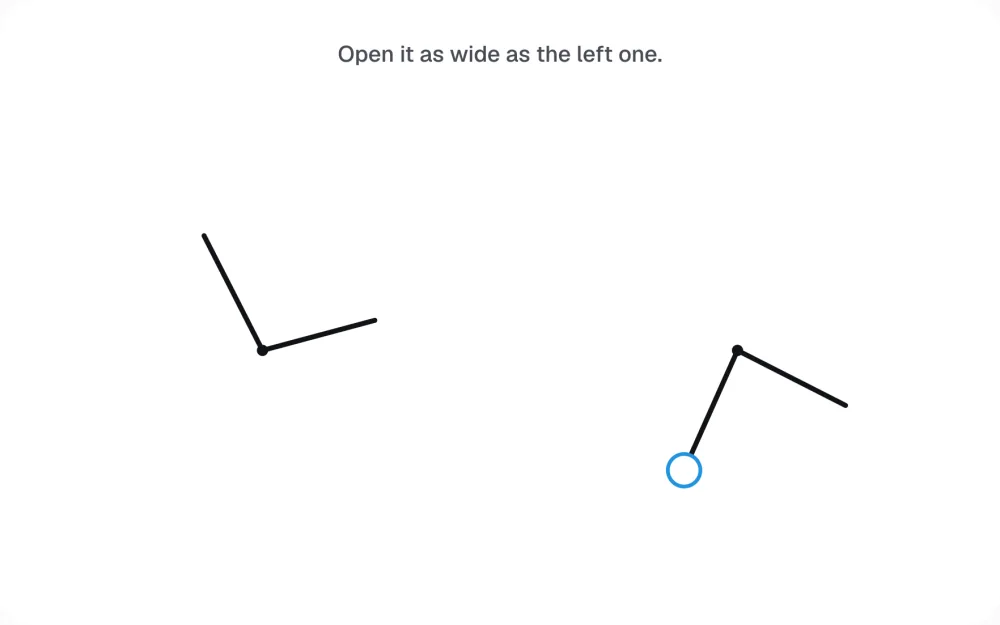
This angle test shows two angles side by side (one above the other on a phone held upright). The left one is fixed. The right one, marked with a ring, can open and close. Your job is to open the right angle exactly as wide as the left one. Only the opening counts, not which way the angle points.
The two angles always point different ways, so you cannot just slide one onto the other in your head. The target is anywhere from 20 to 160 degrees, but never close to a right angle, which would be too easy to spot. On harder rounds the sides have unequal lengths, up to almost half shorter, which makes the angles look less alike.
In the game this test is called Angle Copy, and it opens with its name in soft blue rings and the level written underneath. You know how hard the round will be before the angles appear.
Opening the angle
When the round starts, the right angle is 25 to 60 degrees too wide or too narrow. One of its sides carries a ring in the test's color. Drag anywhere around the corner to swing that side. Your finger never covers the angle, and the further from the corner you drag, the finer the control.
On a computer, the arrow keys open or close the angle one degree at a time. Both angles stay on the board the whole time, so you can compare as long as you like. When they look the same, press Lock in.
Nothing here tests memory. This angle test is about how well your eye judges an opening when everything around it differs: the direction, the side lengths and the place on the board.
How the angle test is scored
Your answer is scored by the difference between your opening and the target, in degrees. A perfect copy scores 100, and the score falls smoothly as the gap grows. Too wide and too narrow count the same.
| You are off by | Score |
|---|---|
| 0° | 100 |
| 2° | 98 |
| 4° | 91 |
| 6° | 80 |
| 8° | 67 |
| 10° | 54 |
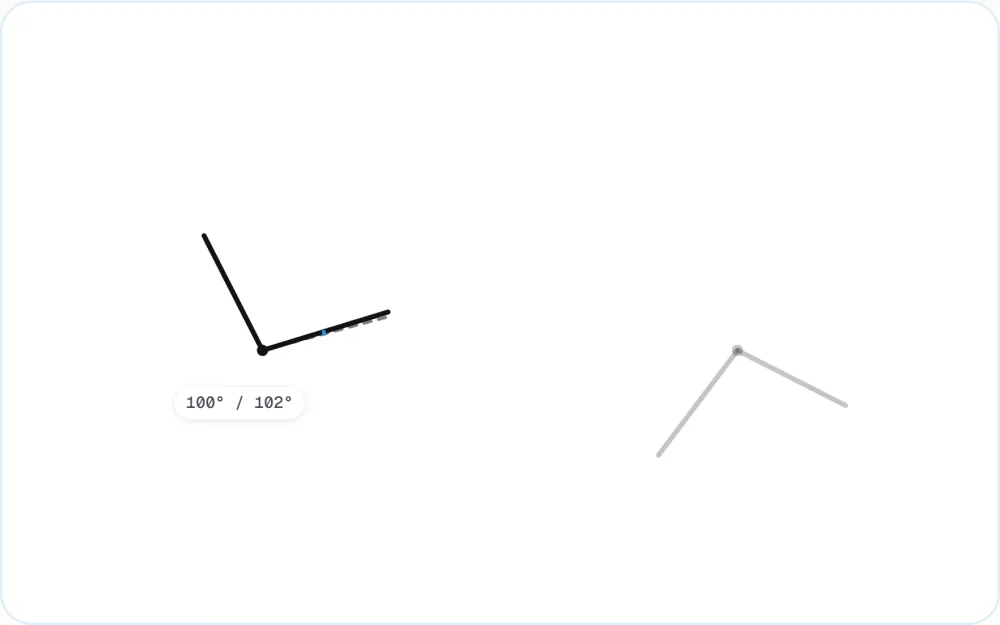
The angle test is strict: a few degrees cost real points. After you lock in, the true opening is drawn in gray over yours, and a small label says how far off you were, such as 4° too wide. In the daily game, the reveal can also show the share of players who went too wide and the share who went too narrow.
What an angle test tells you about your eye
An angle test checks one of the basic jobs of vision: judging angles. Cells early in the visual system respond to edges at particular slants, and the brain combines them to read corners, shapes and slopes. Even so, people are far from perfect at it.
A few biases are well known. Sharp angles tend to look a little wider than they are, and wide angles a little narrower, as if everything were pulled toward a right angle. Angles near level or upright are judged better than ones at a slant. And longer sides make an angle look more open than the same angle with short sides.
That is why this angle test turns the two angles different ways and, on harder rounds, changes the side lengths. The only fair way to match them is to judge the opening itself.
Tips for a better angle test score
- In any angle test, compare each angle with a right angle first. Decide how much wider or narrower the left one is, then copy that.
- Ignore the side lengths. A short side opens the same angle as a long one.
- Look at the gap between the sides, not the sides themselves.
- Tilt your head, or picture the right angle turned to match the left one, before the final nudge.
- Watch for the pull toward a right angle. If your sharp angles come out too wide, close them a little.
The reveal shows whether you tend to go too wide or too narrow. Most people find one direction comes up again and again, and a small correction fixes it.
Angle Copy in the daily Perceptle
This angle test is one of seventeen perception tests in Perceptle, a free daily game of ten quick tests, each scored out of 100 for a total out of 1000. Ten of the seventeen are drawn each day and get harder from first to last. Everyone plays the same puzzle on the same date, and a new one arrives at local midnight.
On this practice page each new round is a little harder than the one before. For more geometry by eye, try the mental rotation test or the circle center test. How to play explains the daily game.
Questions and answers
What is a good score on the angle test?
Within 2 degrees scores about 98, and 5 degrees off scores 86. A miss of 10 degrees scores 54.
Does the direction of the angle matter?
No. Only the opening counts. The two angles always point different ways on purpose.
Why are the sides different lengths?
On harder rounds the side lengths change so you cannot match the angles by their tips. You have to judge the opening itself.
Is the target ever a right angle?
No. Targets run from 20 to 160 degrees and stay clear of 90, since a right angle is easy to spot.
Does the angle test work on a phone?
Yes. Drag your finger around the corner to swing the ringed side. Your finger stays clear of the angle.
Is it free?
Yes. Perceptle is free in any browser, with no account and nothing to install.
Judge the opening
The angle test is one of ten quick tests in today's Perceptle. See how your eye for angles compares with your sense of time, color and memory.
Play today's Perceptle