A pattern memory test in one flash
This pattern memory test shows you a grid of light squares, darkens some of them for about a second, then clears the grid. Your job is to tap the squares that were dark. It sounds simple, but a second is short, and the pattern is random every time.
Easy rounds use a 5 by 5 grid with five or six dark squares, shown for about a second. Harder rounds switch to a 6 by 6 grid, darken up to nine squares, and cut the time to 0.7 seconds.
In the game this test is called Grid Flash, and it opens with its name in soft amber rings and the level written underneath. You know how hard the round will be before the grid appears.
Marking the squares you remember
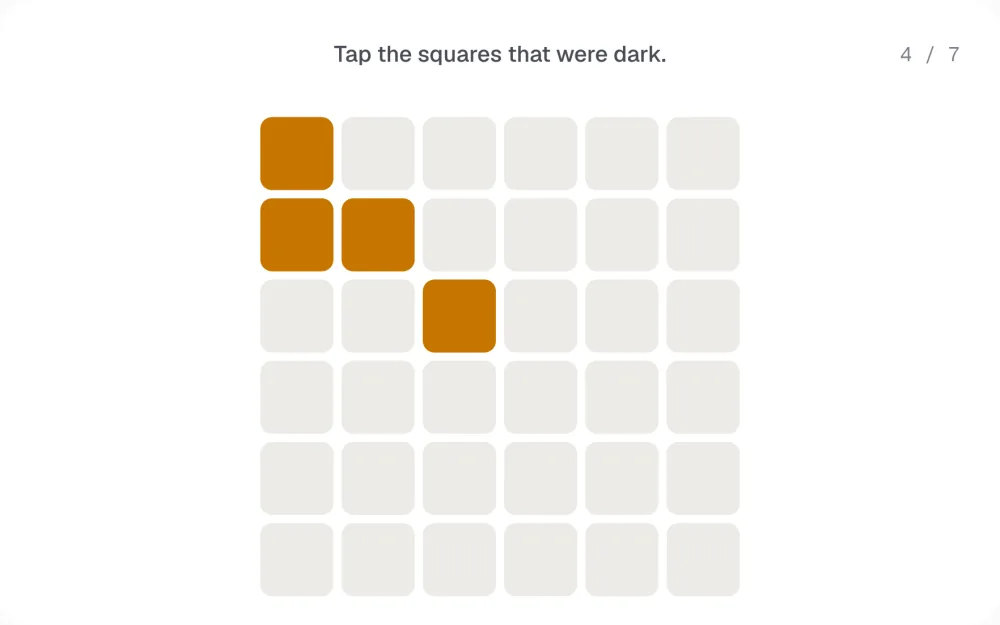
When the dark squares vanish, the empty grid stays on the board. Tap a square to mark it, and tap it again to clear it. Mark as many squares as flashed, then press Lock in.
You can change your mind as often as you like before you lock in. The game does not tell you whether a mark is right until the reveal, so the whole pattern rests on your memory.
Marking extra squares does not help. Every square you mark that was not dark, and every dark square you leave out, costs you points.
How the pattern memory test is scored
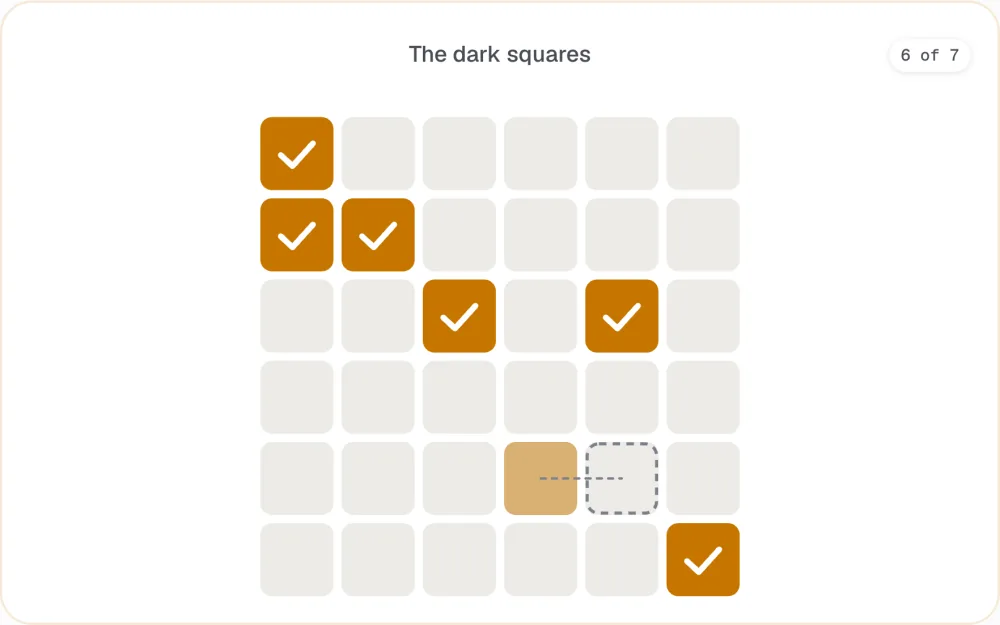
The score is not all or nothing. Each square you mark is paired with the nearest dark square. A mark on the exact square is free. A mark one step away, including a diagonal step, costs half as much as a miss. A mark further away, a dark square you left out, or an extra mark costs the full amount.
The total is then taken as a share of the round, so a round with more squares can absorb a little more. Here is how a round with eight dark squares scores:
| Your marks | Score |
|---|---|
| All eight exactly | 100 |
| One mark a step off | 95 |
| One square missed | 82 |
| Two marks a step off | 82 |
| Two squares missed | 46 |
| Three squares missed | 17 |
After you lock in, the dark squares come back in gray beside your marks, and a small label says how many you placed exactly, such as 6 of 8 exactly. In the daily game, the reveal can also show how everyone else did that day.
What a pattern memory test measures
Visual working memory holds what you just saw for a few seconds after it is gone. It is small. Most people can hold only about four separate items, which is why a pattern memory test with eight squares feels hard even though the grid is plain.
The trick is that a pattern is not eight separate items. People who do well group the squares into chunks: a short line, a corner, a pair on a diagonal. Each chunk takes about as much room in memory as one square would, so the same space holds more.
Researchers use grids like this to study visual memory in children and adults, and the visual patterns test is a common clinical version. Scores rise with practice, mostly because people learn to chunk faster.
Tips for a better pattern memory test score
- Don't try to remember single squares. Look for shapes in the pattern, like a line, an L or a pair.
- Note which part of the grid is crowded and which part is empty. That alone places most squares close.
- Mark the squares you are sure of first, then fill in the rest.
- When you are unsure between two squares, pick one. A mark one step off still earns half.
- Count your marks before you lock in. Extra marks cost as much as missed squares.
After a few rounds of this pattern memory test, most people notice they see the grid in chunks without trying. That is when the scores start to climb.
Grid Flash in the daily Perceptle
This pattern memory test is one of seventeen perception tests in Perceptle, a free daily game of ten quick tests, each scored out of 100 for a total out of 1000. Ten of the seventeen are drawn each day and get harder from first to last. Everyone plays the same puzzle on the same date, and a new one arrives at local midnight.
On this practice page each new round is a little harder than the one before. For more tests of memory, try the visual memory test or the color memory test. How to play explains the daily game.
Questions and answers
What is a good score on the pattern memory test?
Getting every square exactly scores 100. On a round of eight, one square missed scores about 82, and two missed about 46.
Does a nearly right square count?
Yes. A mark one step away from a dark square, even on a diagonal, earns half. Only marks further away count as a full miss.
Should I mark extra squares to be safe?
No. Every mark that does not belong to a dark square costs as much as a miss. Mark as many as flashed.
How long do the squares stay dark?
About a second on easy rounds and 0.7 seconds on the hardest. The grid also grows from 5 by 5 to 6 by 6.
Does the pattern memory test work on a phone?
Yes. Tap the squares with your finger, and tap again to clear one.
Is it free?
Yes. Perceptle is free in any browser, with no account and nothing to install.
See the pattern, not the squares
The pattern memory test is one of ten quick tests in today's Perceptle. See how your memory for patterns compares with your sense of time, color and space.
Play today's Perceptle