What the visual memory test asks of you
The Perceptle visual memory test flashes a handful of colored dots on a board and then hides them. A question follows, such as Where was the blue dot?, and you tap the spot where that dot sat.
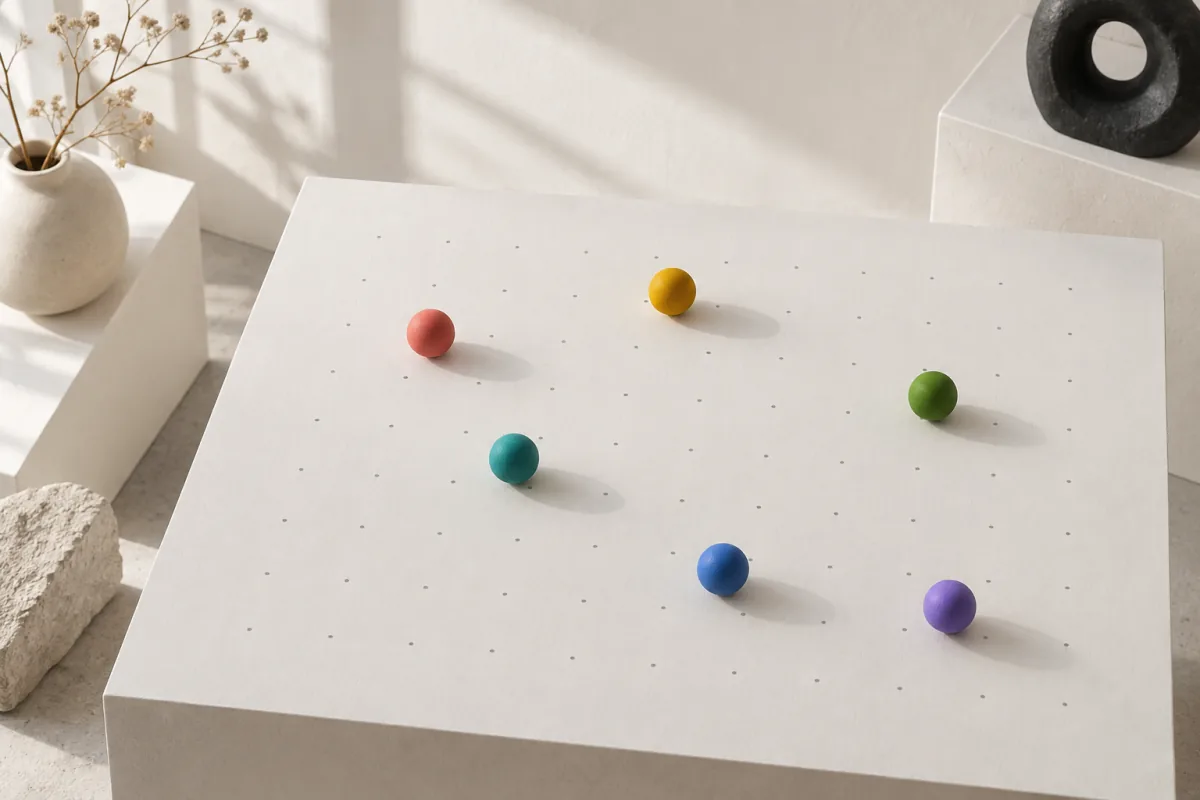
The board carries a faint grid of dots to help you keep your bearings. Between 3 and 7 colored dots appear on it for 0.9 to 1.4 seconds, in red, blue, green, yellow, purple, orange and pink, never two of the same color. They are always spread out, at least 70 units apart on a board 800 units wide and 500 tall, so none of them overlap.
In the game the test is called Spot Memory, and its color is a warm mustard gold. On this practice page each new round is a little harder than the last: more dots, and less time to see them.
One round, step by step
- The dots appear on the grid. Take in the whole layout at once rather than one dot at a time.
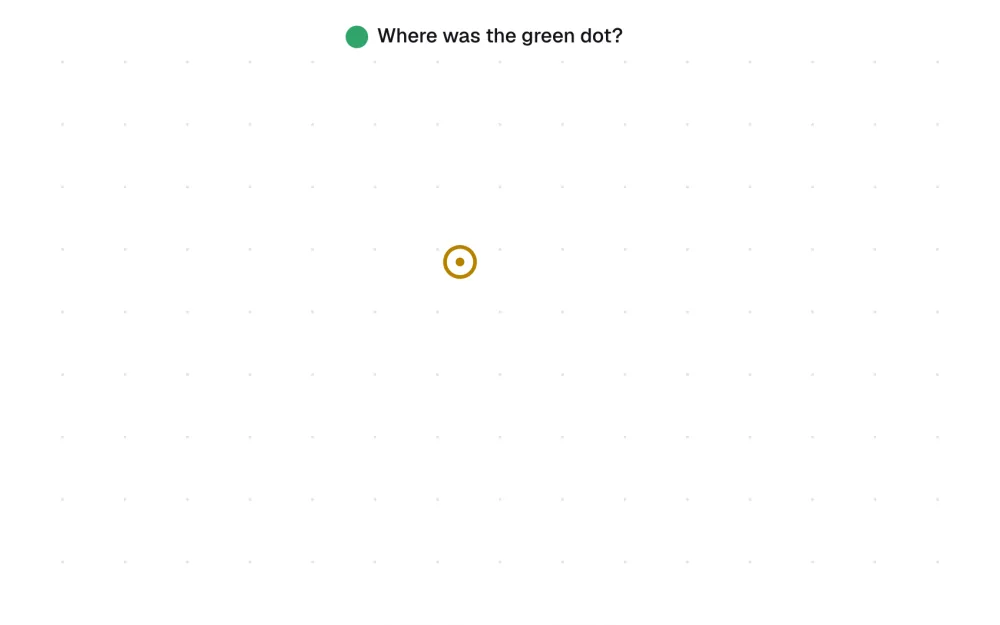
- They vanish, and a question names one color: Where was the green dot?
- Tap where you think it was. A ring marks your pick.
- Drag to adjust if your first tap feels off, then press Lock in.
- The reveal brings every dot back so you can see how close you came.
In the visual memory test you don't know which color will be asked until the dots are gone, so every dot matters. If you switch tabs while the dots are showing, the round is replaced with a fresh one.
How the visual memory test is scored
Your error is the straight-line distance between your pick and the real dot, measured in board units. Each dot is a little under 40 units across, so a miss of 40 puts your ring about one dot's width away.
The score falls away smoothly from 100 as the miss grows:
| Distance from the dot | Score |
|---|---|
| 0 units | 100 |
| 20 units | 88 |
| 40 units | 61 |
| 60 units | 32 |
| 80 units | 14 |
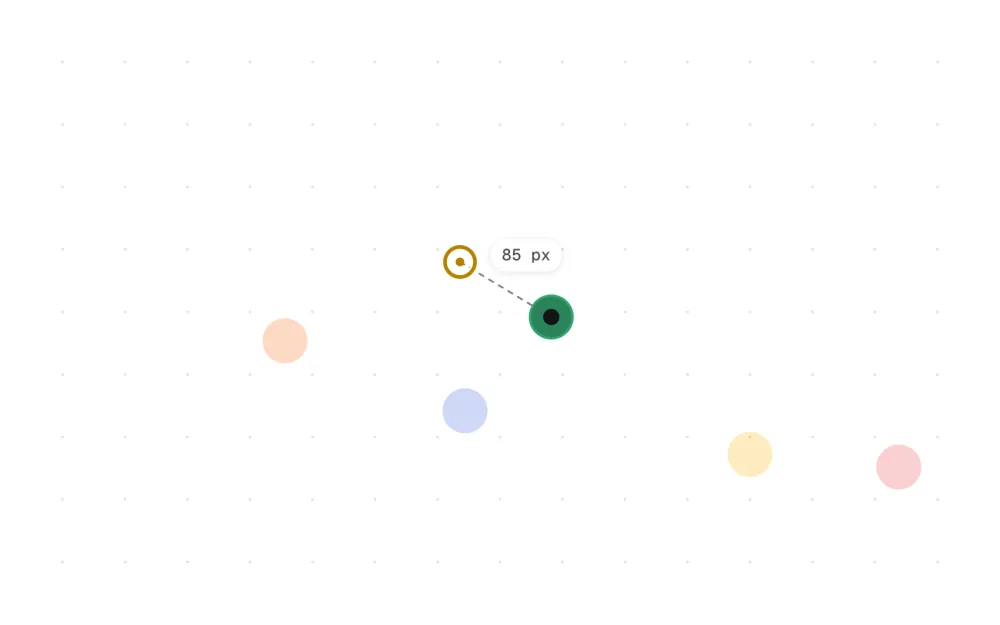
The reveal brings all the dots back, faded, with the one you were asked about shown solid. Your ring sits where you tapped, joined to the real dot by a dashed line with the distance written on it, such as 27 px.
Why four dots is a turning point
A visual memory test like this one leans on visual working memory, the brief store that holds a picture after it is gone. Its capacity is small: most people can hold only about three or four items at once.
That is why the rounds don't get harder smoothly. Three dots feel easy and four still feel fine, but at five or six something has to give, and the dot you are asked about may be one you never quite stored. The jump in difficulty you feel on busier rounds is real.
Working memory holds more when things form a pattern. Chunking the layout into a shape, such as a triangle with a dot in the middle or a rough letter L, lets several dots ride along as one item.
Ways to hold the picture
- Look at the middle of the board, not at any one dot, so the whole layout lands at once.
- See a shape. Join the dots in your head into a triangle, a zigzag or a letter.
- Use the edges and the faint grid as landmarks: near the top left corner, two rows in from the right.
- Don't try to name every color in order; that takes longer than the flash allows. Picture the scene and let the question pick the dot.
- When you are unsure, tap where the dot most likely was. A near miss still scores well.
- Play a run of rounds. The visual memory test gets harder each round here, so your typical score settles after a few.
The visual memory test in your daily ten
This visual memory test is one of twelve tests in Perceptle, a free daily game of ten quick perception tests. Each day ten are drawn from the twelve and get harder from first to last, so Spot Memory shows fewer dots for longer early in the lineup and more dots for less time near the end. Everyone gets the same puzzle on the same date, with a new one at local midnight.
The ten scores make a daily total out of 1000. If you like this one, the color memory test asks you to recall a color instead of a place, and Unlimited mixes all twelve tests into endless rounds.
Questions and answers
What is a good score on the visual memory test?
Landing within 20 units of the dot scores 88, and within 40 units, about one dot's width, scores 61. Scores in the 80s and 90s mean you placed it almost exactly.
How many dots can people remember?
Most people hold about three or four items in visual working memory at once. Past that, chunking the dots into a shape is what helps.
Does the faint grid help?
Yes, as a set of landmarks. The grid stays on the board after the dots vanish, so a dot you remember as two rows from the top can be placed against the same marks.
Will two dots ever be the same color?
No. Each dot in a round has its own color, so the question always points to exactly one.
Why did the round restart when I switched tabs?
Tests that flash something are replaced with a fresh round if you switch tabs mid-flash, so nobody gets a second look.
Does the visual memory test work on a phone?
Yes. On a phone held upright the board turns to fill the screen, giving you more room to place your pick.
Is it free?
Yes. Perceptle is free in any browser, with no account and nothing to install.
Nine more tests are waiting
The visual memory test is one of ten quick tests in today's Perceptle. Find out how well your senses judge time, color, memory and space.
Play today's Perceptle