A motion perception test in one glance
This motion perception test fills a round window with about 110 small dots and sets them moving for a second or two. Some of the dots move together, all in the same direction. The rest wander off in directions of their own. Then every dot vanishes, and you point an arrow the way the group drifted.
No single dot gives the answer away. Any dot you follow might be one of the wanderers, so the only way to see the drift is to take in the whole cloud at once. Your eyes and brain add up hundreds of tiny movements into one overall flow, and that flow is what you report.
In the game this test is called Drift, and it opens with its name in soft teal rings and the level written underneath. On easy rounds more than half of the dots move together for 1.8 seconds. On the hardest rounds only about one dot in five does, for 1.1 seconds.

Pointing the arrow
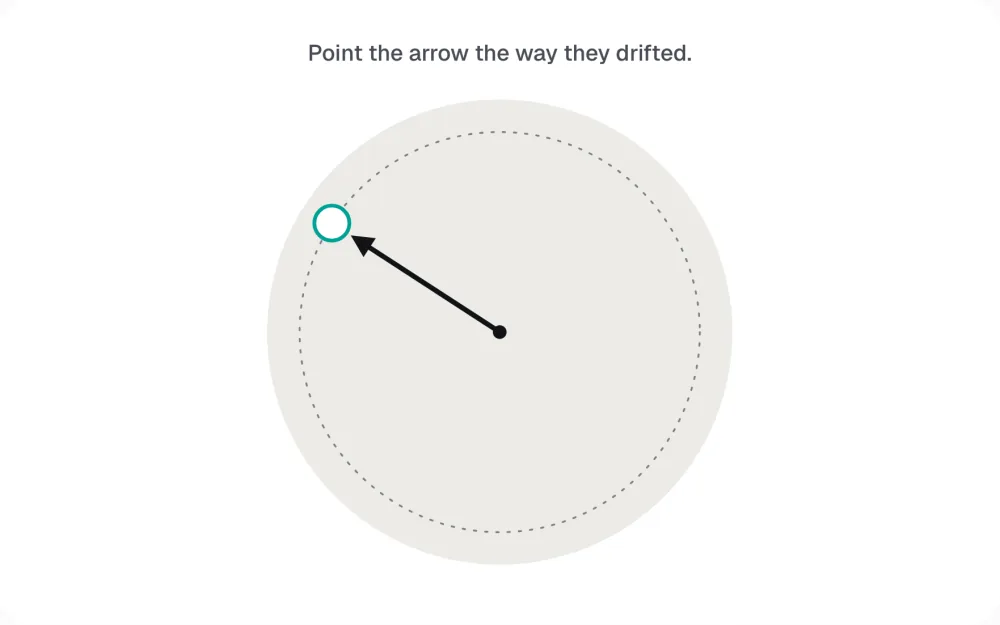
When the dots disappear, an arrow appears in the middle of the empty window. It starts out pointing somewhere else, never at the answer. Drag anywhere on the board to turn it: the arrow follows your finger or mouse around the middle, and the further out you drag, the finer the control.
On a computer, the arrow keys turn it one degree at a time, which helps with the last small nudge. Turn as often as you like. When the arrow points the way the dots drifted, press Lock in.
The drift can go any way round the circle, but never straight up, down, left or right. Those four would be too easy to judge against the edges of the screen, so every round makes you read the motion itself.
How the motion perception test is scored
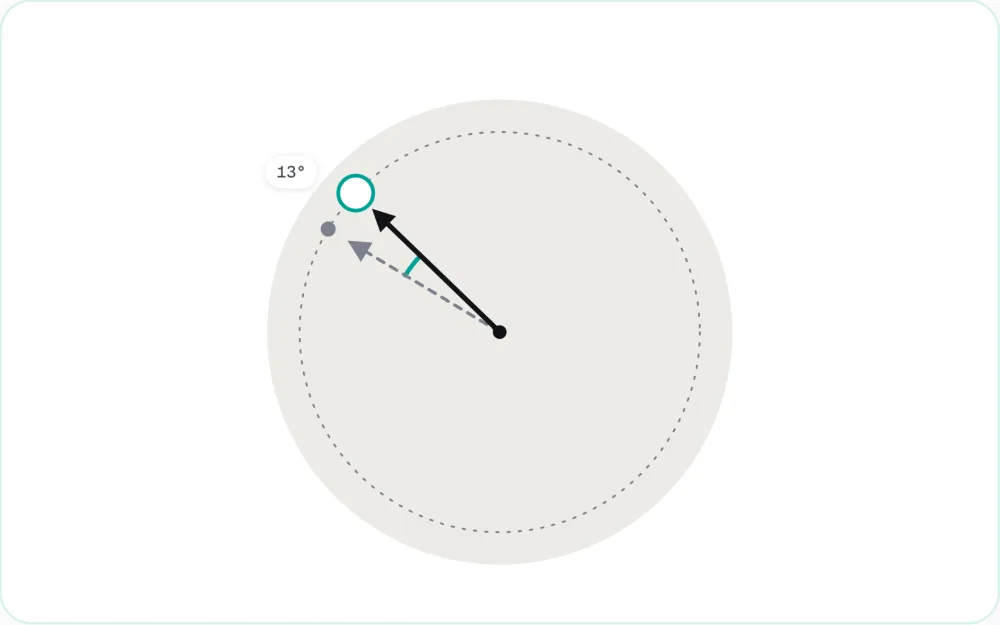
Your answer is scored by the angle between your arrow and the true direction, the short way round. Pointing exactly the right way scores 100, and the score falls smoothly as the angle grows. It does not matter which side you miss on.
| You are off by | Score |
|---|---|
| 0° | 100 |
| 5° | 97 |
| 10° | 90 |
| 15° | 79 |
| 20° | 66 |
| 30° | 39 |
| 45° | 12 |
After you lock in, the true direction is drawn as a dashed gray arrow beside yours, a colored arc joins the two, and a small label gives the angle between them, such as 12°. Below the board you see how far off you were and which way the dots really went.
The science behind a motion perception test
Clouds of moving dots like these are one of the most used tools in vision science. Researchers call them random dot kinematograms. They became famous in the late 1980s and early 1990s, when studies by William Newsome and colleagues linked how well monkeys judged the drift of such a cloud to the activity of single cells in a brain area called MT, also known as V5. That area seems to be built for exactly this job: pooling many small, local motions into one overall direction.
The key setting is coherence, the share of dots that move together. With every dot in step, the direction is obvious. As fewer dots move together, the drift fades into the noise, and at some point people can no longer tell which way it goes. That point is a person's motion coherence threshold, and it is used to study ageing, reading, attention and many other topics.
This motion perception test is a quick, playful version of that classic task. Instead of asking left or right, it asks for the direction itself, anywhere round the circle, so even a small miss shows up in your score.
Tips for a better motion perception test score
- Don't follow one dot. Rest your eyes near the middle of the window and let the whole cloud flow past.
- The wanderers cancel each other out. Look for the stream that keeps going the same way.
- Before the dots vanish, name the direction as a clock time, such as four o'clock or half past ten.
- Point the arrow roughly first, then compare it with your clock time and make the last small turn.
- On a computer, use the arrow keys for the last few degrees.
Most misses on the motion perception test come from the hardest rounds, where only a few dots move together. Staying relaxed and taking in the whole window helps far more than staring hard at one spot.
Drift in Perceptle
Drift is one of the newest tests in Perceptle, a free daily game of quick perception tests, each scored out of 100. For now it plays in Perceptle Unlimited and here on this practice page, while its scoring is tuned from real answers. Once that is done, it joins the draw for the daily puzzle.
On this practice page each new round of the motion perception test is a little harder than the one before, and you can pick a level from Easy to Extreme. For more tests of motion, try the speed perception test or the timing test. How to play explains the daily game.
Questions and answers
What is a good score on the motion perception test?
Pointing within 10 degrees scores about 90, and 20 degrees off scores 66. Easy rounds are often judged within 10 degrees; the hardest rounds are much harder.
Do most of the dots move the same way?
On easy rounds, yes: more than half of them do. On the hardest rounds only about one in five moves with the group, and the rest wander at random. The answer is always the group's direction.
Can I see the dots again before I lock in?
No. They move once, for 1.8 seconds on easy rounds and 1.1 seconds on the hardest. Holding the direction in mind is part of the test.
Does the motion perception test work on a phone?
Yes. Hold the phone upright or sideways. Drag your finger anywhere on the board to turn the arrow, so your finger never covers it.
Is it free?
Yes. Perceptle is free in any browser, with no account and nothing to install.
Read the drift
Try the motion perception test a few rounds at a time, then see how your sense of motion compares with your sense of time, color and memory in today's Perceptle.
Play today's Perceptle