The shade matching test, step by step
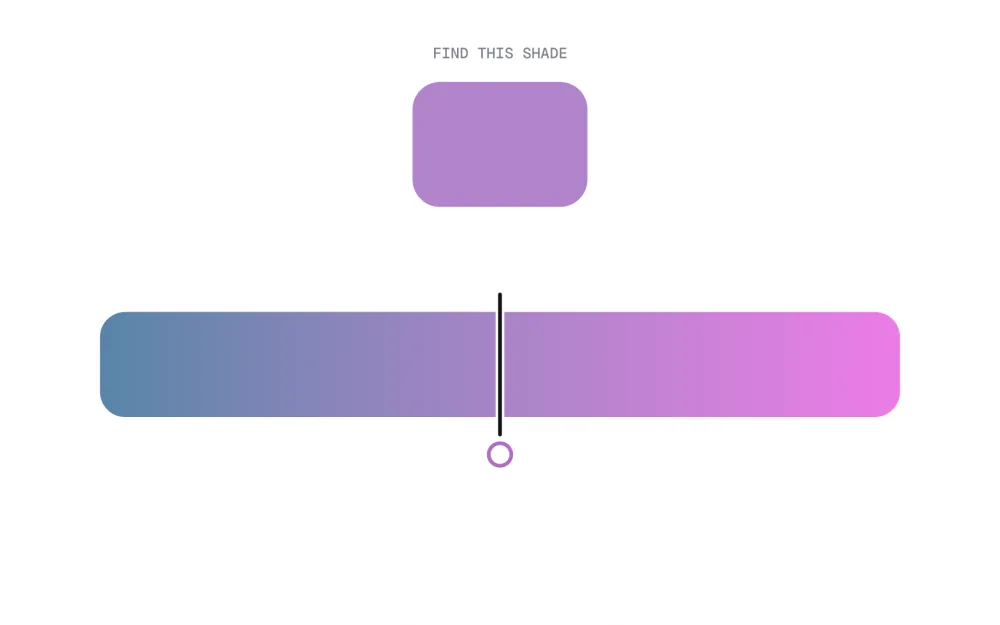
The shade matching test gives you two things to compare. At the top, under the words Find this shade, sits a single swatch of color. Below it, a gradient bar fades smoothly from one color to another. Somewhere along that bar is the exact shade in the swatch.
Tap the bar where you think the shade sits, drag your marker to adjust it, then press Lock in. The shade can be anywhere from 8% to 92% of the way along, so it is never right at one end.
The two end colors change every round, in hue as well as lightness, so each round is a fresh pair to read rather than a bar you have seen before. The bar blends evenly from end to end, so a shade halfway between the two end colors sits halfway along.
What a shade matching test measures
Locating a color along a gradient is a test of color discrimination: telling apart small differences in hue and lightness. Neighboring shades on the bar differ only slightly, and the whole skill is noticing which way the swatch leans.
It is also a test of not being fooled. What surrounds a color changes how we see it, an effect called simultaneous contrast. The same shade looks lighter against darker neighbors and darker against lighter ones. The swatch sits on its own, while each spot on the bar is flanked by its neighbors, so a perfect match can look slightly off.
That is why a shade matching test is harder than it sounds. You are comparing colors and, at the same time, seeing past the context your eyes add to them.
How to match a shade more accurately
A few habits make a real difference, on the first round of a shade matching test and on the tenth. Along most bars, lightness and hue shift at the same time, so it pays to check them one at a time.
- Compare lightness first. Ask whether the swatch is lighter or darker than the middle of the bar, which tells you which half to search.
- Then compare hue. Once you are in the right area, check whether the swatch leans toward one end color or the other.
- Look back and forth between the swatch and the bar rather than staring at either one. Quick glances make small differences easier to spot.
- Place your mark, then check the colors just either side of it. If the swatch matches one side better, nudge toward it.
- Trust the swatch over the impression around it. Neighboring colors on the bar can make a spot look lighter or darker than it is.
How shade matching test scores work
Your error is the gap between your mark and the true spot, as a share of the bar's length. Like every Perceptle test, the score runs from 0 to 100 and falls away smoothly, so a near miss still earns most of the points.
| Off by (share of the bar) | Score |
|---|---|
| On the spot | 100 |
| 2.5% | 88 |
| 5% | 61 |
| 7.5% | 32 |
| 10% | 14 |
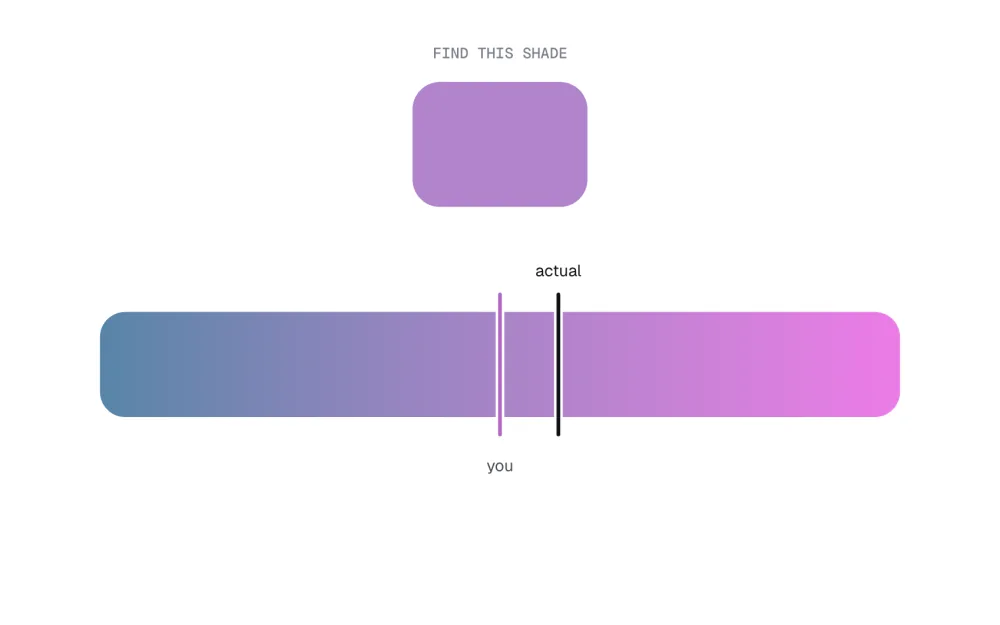
When you lock in, two marks appear on the bar, labeled you and actual. The result reads something like 53% along, with Actual 57% beside it, so you see both how far off you were and in which direction.
Harder rounds: end colors that sit closer together
On harder rounds the two colors at the ends of the bar are closer together, so neighboring shades differ less. A bar with very different ends gives you plenty to read. A bar between two near neighbors leaves you sorting out differences that are barely there.
On this practice page each new round is a little harder than the one before. In the daily game the ten tests get harder from first to last, so a shade matching test late in the lineup brings one of the narrow bars.
Each round opens on a brief with the test's in-game name, Shade Finder, and the level word beneath it.
Play it with nine other tests
This shade matching test is one of twelve perception tests in Perceptle, a free daily game of ten quick tests. Everyone gets the same puzzle on the same date, a new one arrives at local midnight, and your ten scores add up to a total out of 1000.
If color is your strength, try the color memory test, which shows a color for a moment and asks you to find it again. Unlimited mixes all twelve tests into endless rounds, and How to play walks through the daily game.
Questions and answers
What is a good score on the shade matching test?
Landing exactly on the spot scores 100. Being off by 2.5% of the bar's length scores 88, and 5% scores 61.
Why does the swatch look different from the matching spot?
Surroundings change what we see. Neighboring colors on the bar push a spot's look lighter or darker, while the swatch sits on its own. Compare lightness, then hue, rather than the overall impression.
Is the shade ever at the very end of the bar?
No. It always sits between 8% and 92% of the way along.
Does my screen matter?
It can. A very dim screen or a color filter can make neighboring shades harder to tell apart, so compare scores on the same device with the same settings.
Can I play on a phone?
Yes. Hold your phone upright and the board turns to fill the screen, which gives the bar more length to tap on.
Is this shade matching test the same as the one in the daily game?
Yes. Here the rounds keep coming and get a little harder each time. In the daily Perceptle it appears once, when it is drawn, at a difficulty set by its place in the lineup.
Is it free?
Yes. Perceptle is free in any browser, with no account and nothing to install.
See how your eye compares
The shade matching test is one of ten quick tests in today's Perceptle. Put your eye for color next to your sense of time, space and memory.
Play today's Perceptle