A dot count test in one flash
This dot count test shows you a cloud of dots for about a second, then takes it away. Your job is to say how many there were. That is far too fast to count, so you go by the overall impression, and that is the whole point.
All the dots are the same size and the same color, so nothing helps you except the number. Easy rounds flash 10 to 25 dots for about a second. The hardest rounds flash 25 to 80 dots and cut the time to 0.6 seconds.
In the game this test is called Dot Count, and it opens with its name in soft purple-pink rings and the level written underneath. You know how hard the round will be before the dots appear.
Setting your estimate on the number line
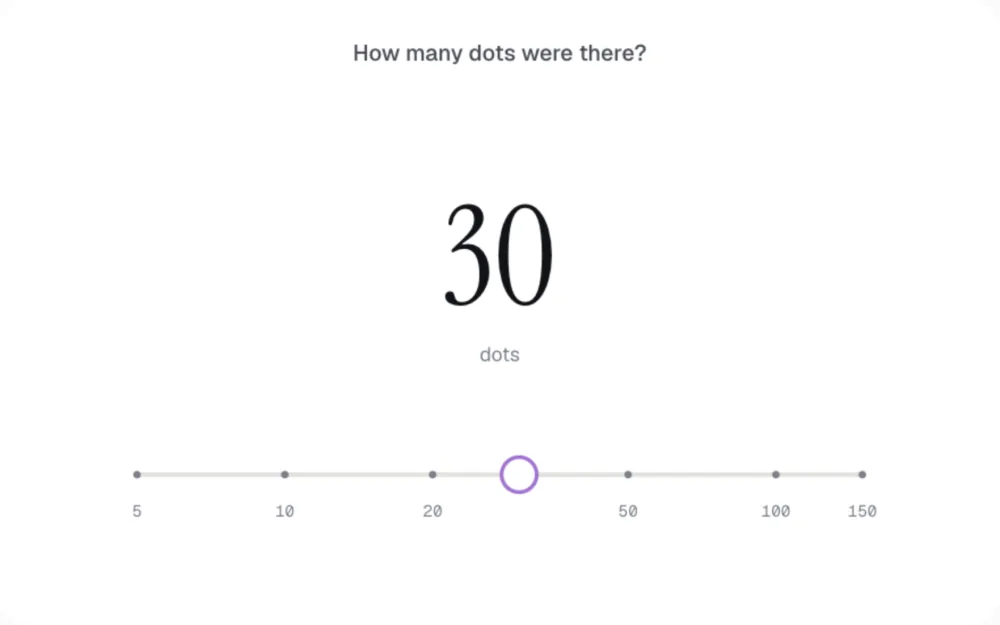
When the dots vanish, the game gives you a number line running from 5 to 150. It is spaced so that equal steps are equal ratios, which means the distance from 10 to 20 is the same as the distance from 50 to 100. Marks at 10, 20, 50 and 100 help you find your place.
Drag left or right to set your estimate. Your number shows large in the middle of the screen as you move, so you always know what you are about to say. When you are happy with it, press Lock in.
The odd spacing makes sense once you try it. Telling 10 dots from 20 is easy, and telling 100 from 110 is nearly impossible, so the line gives small numbers more room and big numbers less.
How the dot count test is scored
Your answer is scored by ratio, not by difference. Being 5 off when there were 50 dots counts the same as being 1 off when there were 10. Both are a miss of 10%, and both earn the same points.
A perfect answer scores 100, and the score falls smoothly as the ratio grows. Guessing too few costs a little more than guessing too many by the same percentage, which is why the two sides of the table differ.
| Your estimate | Score |
|---|---|
| Spot on | 100 |
| 10% too many | 91 |
| 10% too few | 89 |
| 20% too many | 71 |
| 20% too few | 60 |
| 30% too many | 49 |
| 30% too few | 27 |
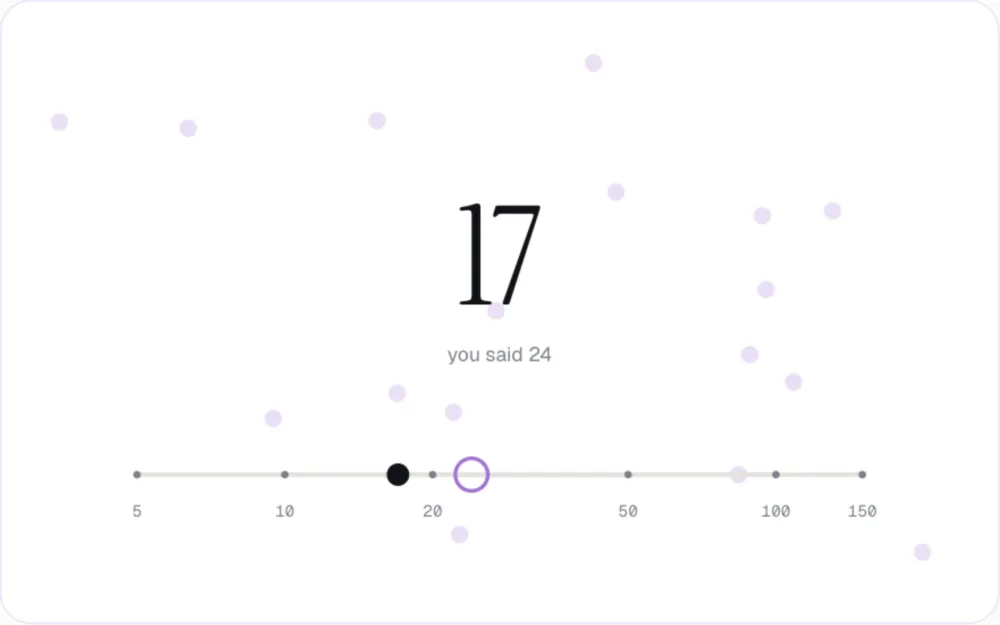
After you lock in, the dots come back and the true count is shown. Your guess and the true count are both marked on the number line, and the verdict tells you how far off you were as a percentage, such as 12% too few. In the daily game, the reveal can also show how everyone answered that day: the share of players who guessed too few and the share who guessed too many.
Why a dot count test measures a number sense
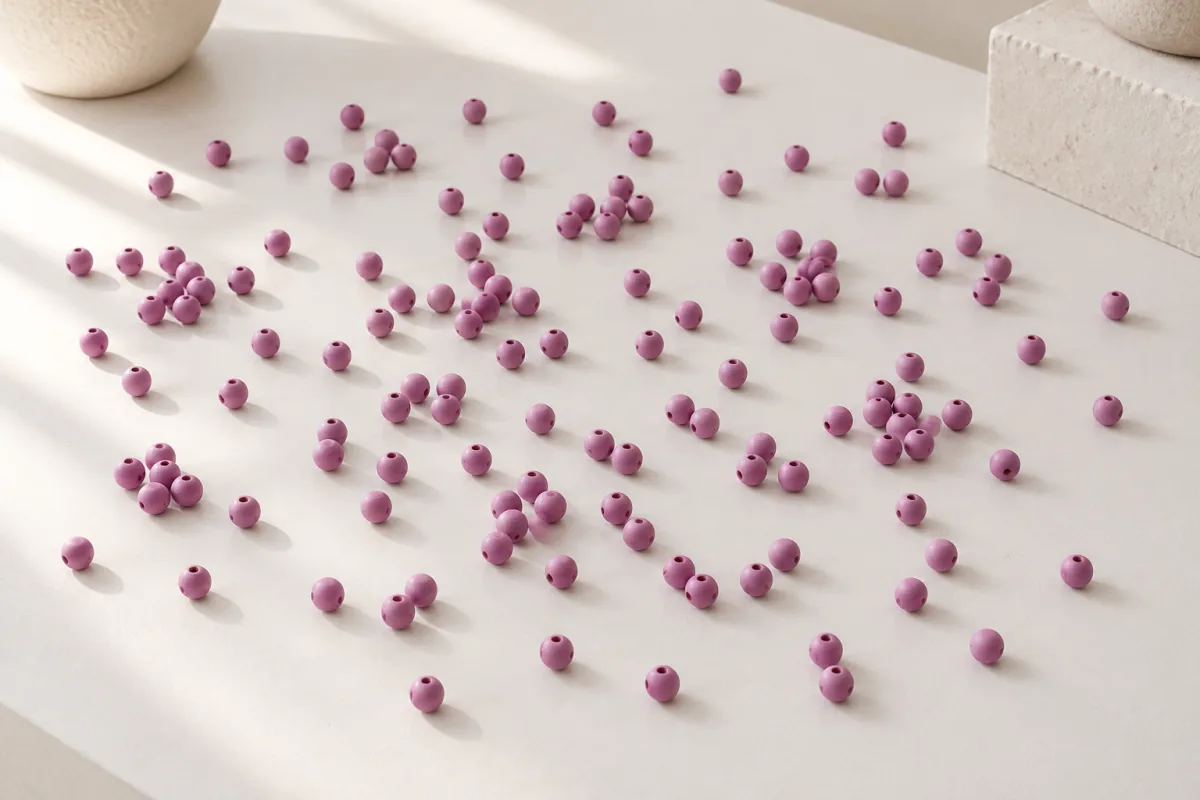
People, and many animals, have an approximate number sense. It lets us judge how many things are in front of us without counting them, and it works from early childhood. Flashing a cloud of dots is a plain way to put that sense to work.
Very small sets, about four items or fewer, are seen at a glance. This is called subitizing, and it feels like knowing rather than guessing. Beyond that, the sense turns into estimation, and the estimates get fuzzier in proportion to the size of the set. Telling 20 from 25 is about as hard as telling 40 from 50, which is why this dot count test scores by ratio.
Two habits show up again and again. Most people tend to underestimate large sets, so a crowded cloud often looks emptier than it is. And the layout matters: spreading the dots out, clustering them and leaving empty space all change how many seem to be there.
Tips for a better dot count test score
- Don't try to count. A second is too short, and half-counting makes you lose the overall impression.
- Take in the whole cloud at once, the way you would take in a crowd.
- Picture the cloud split into quarters, estimate one quarter, and multiply by four.
- Use the marks on the number line as anchors. Decide whether your estimate sits above or below 20, 50 or 100, then refine.
- Check whether you tend to guess low. The reveal shows your misses as too few or too many, and a run of too few means you can nudge your answers up.
Most people find that the first impression is better than the second thought. After a few rounds, the reveal makes your habits plain, and correcting them is usually quick.
Dot Count in the daily Perceptle
This dot count test is one of thirteen perception tests in Perceptle, a free daily game of ten quick tests, each scored out of 100 for a total out of 1000. Ten of the thirteen are drawn each day and get harder from first to last. Everyone plays the same puzzle on the same date, and a new one arrives at local midnight.
On this practice page each new round is a little harder than the one before. For more tests of looking quickly and remembering, try the visual memory test or the average estimation test. How to play explains the daily game.
Questions and answers
What is a good score on the dot count test?
Landing within 10% of the true count scores about 89 to 91, and 20% off scores 60 to 71, depending on whether you guessed too few or too many.
Why can't I just count the dots?
The dots flash for about a second, and on the hardest rounds for 0.6 seconds. That is too fast to count, so the test measures your estimate instead.
Why does the dot count test score by ratio?
Our number sense gets fuzzier as the set grows. Missing 50 dots by 5 is as good as missing 10 dots by 1, so the score looks at the percentage you were off.
Can I adjust my estimate before I lock in?
Yes. Drag left or right as often as you like, then press Lock in when you are happy with the number.
Does the dot count test work on a phone?
Yes. Drag your finger along the number line, and the number shows large in the middle of the screen.
Is it free?
Yes. Perceptle is free in any browser, with no account and nothing to install.
Trust your first glance
The dot count test is one of ten quick tests in today's Perceptle. See how your sense of number compares with your sense of time, color and memory.
Play today's Perceptle